Superhero

20110619-111639.jpgMy son announced this morning, in the car, that he has the superpower of sellotape. This enables him to stick inanimate objects together almost at will.

Fired from his hands in the manner of Spiderman’s webs, I remarked that his sellotape shots could prove mighty useful at present wrapping time. But his sister wasn’t impressed.

‘Show us then’ she challenged him. But he demurred. ‘I’m only a superhero on Tuesdays’ he said, confounding her. It’s hard work saving the world with sellotape, you have to sympathise. None of us can be a superhero every day.

Elemental

The late Herbert McCabe wrote with almost scientific beauty on Aristotle and Aquinas. There is a tightness and precision which bespeaks a lifetime’s reflection and contemplation.

The international physics community has just acknowledged two new superheavy elements – 114 and 116 – which can only be made by man. In his book ‘On Aquinas’, McCabe has fused together all the elements in philosophical symmetry from the two historic heavyweights: Aristotle and Aquinas.

He manages some lighter metaphors though. Describing the difference between following rules and developing virtue he draws on football. Learning the rules of football won’t make you a good player, practice alone makes perfect. Similarly our ‘friends’, in the Aristotelian sense, are our purpose, practice and team-mates. Here’s what he has to say:

From the point of view of moral philosophy the game is friendship (philia) in the sense which Aristotle described it as that relationship by which people are fellow-citizens; and it is more than justice. Justice is the minimum proper relationship with foreigners, but, in addition to this, citizenship demands a concern for the flourishing of your friends, a concern, therefore for their virtues and their concern for my virtues. Friendship is both the aim of all the virtues and also the necessary means by which virtues are cultivated, sustained and developed. Virtues can only be taught by friends. Friendship can only be sustained by virtues.

Past thinkers have discovered all the elements of the ethical periodic table. But McCabe showed there are still elegant and beautiful new ways to bring them together.

Xerxes

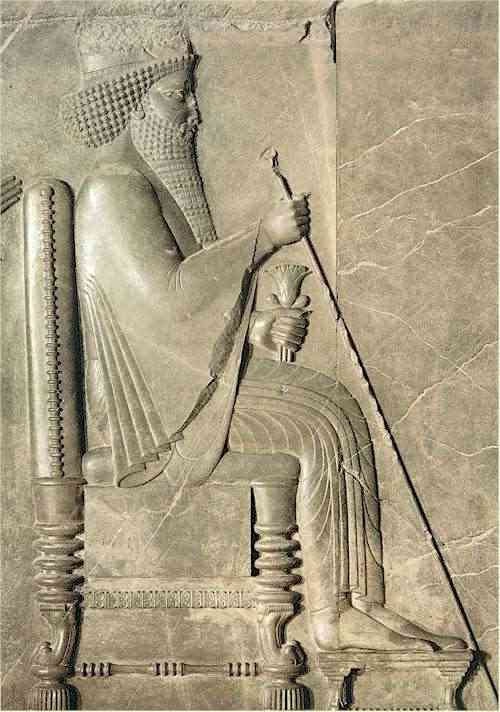
Xerxes – controversially portrayed as a narcissistic androgynous giant in the blood-spattered film 300 – broke with Persian tradition and laid waste to allies and enemies with enormous forces, before losing interest, losing ground and retiring to lotus eating and luxury. Or so some say.

His patina of invincibility was chipped by Leonidas’s legendary 300 Spartans’ suicidal defiance at the ‘hot gates’ of Thermopylae. A Persian General said of them: “Ye Gods, Mardonius, what men have you brought us to fight against? Men that fight not for gold, but for glory.” Spartans sought their immortality in glorious death.

In film and folklore Xerxes was a god amongst men before succumbing to human frailties. Is Xerxes a myth, a legend or history? Probably a bit of all three. A reading of Robert Graves’ Greek Myths suggests most ancient history, legend and mythology is in fact a bit of all three.

But a tale from Montaigne’s suggests that even as Xerxes set out to conquer all, he saw, in the same instant, the limits to his dominance:

Montaigne XXXVII

Artabanus coming by surprise once upon his nephew Xerxes, chid him for the sudden alteration of his countenance. He was considering the immeasurable greatness of his forces passing over the Hellespont for the Grecian expedition: he was first seized with a palpitation of joy, to see so many millions of men under his command, and this appeared in the gaiety of his looks: but his thoughts at the same instant suggesting to him that of so many lives, within a century at most, there would not be one left, he presently knit his brows and grew sad, even to tears.

Greek myths tell us that power and glory are always transient. Even the most powerful among us are mayflies in historical, let alone geological time. Xerxes is a reminder that men cannot be gods. We have at best three score and ten, whether we are millions or 300 men. It behoves us to use our time well.

Poetry in Motion

A few weeks ago, newly enamoured of poetry, I wrote a short ditty to capture what I think increasingly drives my life. It came out quite easily so I guessed it might be quite close. But then I forgot about it. Sat in traffic in the rain today, the last two lines came back to me unbidden. It has clearly lodged in my subconscious. So here it is:

Pay attention to life with bright eyes and keen ears.
Helped by poets and thinkers, refine hopes; master fears.

Embroider each minute and day of my years
with friendship and love and knowledge and ideas.

And the main credits are: for line 1) Montaigne and Aristotle; line 2) Aristotle, Kay, Csikszentmihalyi, Nietzsche, Homer, Armitage, Aquinas, McCabe, Socrates, Stoics, Sceptics; line 3) Me latterly; and line 4) Aristotle, Aquinas, my Friends in Contemplation, my family, reading, writing, work.

I’m not sure I’ll get a poster on the subway for these lines of rhyme, but they are pretty much where Eudaimonia lies for me I think.

Stamps

I’ve written before on the topic of ‘flow’, children and embroidering life with rich experience – large and small. And we managed all four this morning, thanks to a cheap packet of world stamps.

The agile, and occasionally restless, mind of my now seven-year old daughter was completely and delightfully absorbed in sifting stamps from España, Nederland, Polski and the long forgotten Deutsche Democratik Republik.

Some of these stamps were around when I was her age. And the fiddly licky hinges haven’t changed either. Throw in a cheap album and she was completely absorbed in finding countries, licking hinges and sticking in stamps – despite her brother’s periodic attentions.

We learnt some geopolitics – there are 200 odd countries to find, different political systems from democracies to dictatorships and some memorable symbols and landmarks – from the Statue of Liberty, to St Martin from Czechoslovakia on his snowy white horse.

And all for a tenner. Stamps trumped her Nintendo for prolonged attention and ‘flow’ and we learned some things too. Cards, chess, stamps, books – the old favourites are still the best for kids sometimes.