Confrontation and Compassion

Compassion came up a number of times this week – on Tuesday in the context of confrontation; and yesterday as a way to run an entire organisation. Of course the Dalai Lama and Archbishop Desmond Tutu would argue (in the book I’m reading below) that compassion is what we should use to run the entire world.

Back to confrontation through – a colleague of mine was arguing for a ‘public hanging’ to show that the behaviour of some people will no longer be tolerated. I said I felt not; I was accused of appeasement. 

That stung a bit, but my considered counter was: when I’ve ‘gone to war’ with people at work all manner of ills have followed – for me, them and everyone around us. 

So I offered what The Book of Joy suggests instead:

“There is an important distinction between forgiveness and simply allowing others’ wrongdoing. Sometimes people misunderstand and think forgiveness means you accept or approve of wrongdoing. No, this is not the case. We must make an important distinction.” The Dalai Lama was speaking emphatically, striking on hand against the other. “The actor and the action, or the person and what he has done. Where the wrong action is concerned, it may be necessary to take appropriate counteraction to stop it. Towards the actor, or the person, however you can choose not to develop anger and hatred. This is where the power of forgiveness lies – not losing sight of the humanity of the person while responding to the wrong with clarity and firmness. 

This is easier to say than do – both ways. I sometimes find it hard to respond quickly to a ‘wrong’ with ‘clarity and firmness’ without drawing on anger; and once the incident has passed, it feels like I’ve missed the moment and the best thing is probably to move on. But the Dalai Lama invites me to do better: 

“We stand firm against the wrong not only to protect those who are being harmed but also to protect the person who is harming others, because eventually they, too, will suffer. So it’s out of a sense of concern for their own long term well-being that we stop their wrongdoing… We do not let anger and negative feelings develop, but we strongly oppose their actions.”

Desmond Tutu sets out the personal benefit of forgiveness, which I buy completely and have experienced fully in recent years: 

“Forgiveness is the only way to heal ourselves and be free from the past. Without forgiveness, we remain tethered to the person who harmed us. We are bound to the chains of bitterness, tied together, trapped. Until we can forgive the person who harmed us, that person will hold the keys to our happiness, that person will be our jailor. When we forgive, we take back control of our own fate and feelings. We become our own liberator.”

The Dalai Lama picks up: 

“So it is totally wrong,” he said emphatically, cutting his hand sharply through the air, “to say that practice of tolerance and practice of forgiveness are signs of weakness. Totally wrong. Hundred percent wrong. Thousand percent wrong. Forgiveness is a sign of strength.”

The Archbishop adds with a laugh: 

“Those who say forgiveness is a sign of weakness haven’t tried it.”

Forgiveness I have largely cracked. Responding to ‘wrongs’ with ‘clarity and firmness’ but without hot or cold anger… that is a work in progress.

The Emperor’s Questions 


I think I increasingly knew this; but sometimes you need someone to express it clearly for you. Thich Nhat Hahn quoting Tolstoy does the job: 

“One day it occurred to a certain emperor that if he only knew the answers to three questions, he would never stray in any matter.

  1. What is the best time to do each thing? 
  2. Who are the most important people to work with?
  3. What is the most important thing to do at all times?

The emperor issued a decree throughout his kingdom announcing that whoever could answer the questions would receive a great reward. 

Many who read the decree made their way to the palace at once, each person with a different answer.

In reply to the first question, one person advised that the emperor make up a thorough time schedule, consecrating every hour, day, month, and year for certain tasks and then follow the schedule to the letter. Only then could he hope to do every task at the right time.

Another person replied that it was impossible to plan in advance and that the emperor should put all vain amusements aside and remain attentive to everything in order to know what to do at what time.

Someone else insisted that, by himself, the emperor could never hope to have all the foresight and competence necessary to decide when to do each and every task and what he really needed was to set up a Council of the Wise and then to act according to their advice. 

Someone else said that certain matters required immediate decision and could not wait for consultation, but if he wanted to know in advance what was going to happen he should consult magicians and soothsayers.

The responses to the second question also lacked accord. One person said that the emperor needed to place all his trust in administrators, another urged reliance on priests and monks, while others recommended physicians. Still others put their faith in warriors.

The third question drew a similar variety of answers. Some said science was the most important pursuit. Others insisted on religion. Yet others claimed the most important thing was military skill.

The emperor was not pleased with any of the answers, and no reward was given.”

It took a life and death experience with a hermit (here) to reveal the answer to the emperor, which Tolstoy says quite simply is this: 

“The present moment is the only time over which we have dominion. 

The most important person is always the person you are with, who is right before you.

The most important pursuit is making the person standing at your side happy, for that alone is the pursuit of life.”

As Thich Nhat Hahn goes on to say: 

“Tolstoy’s story is like a story out of scripture: it doesn’t fall short of any sacred text. 

We talk about social service, service to the people, service to humanity, service for others who are far away, helping to bring peace to the world-but often we forget that it is the very people around us that we must live for first of all. 

If you cannot serve your wife or husband or child or parent – how are you going to serve society? 

If you cannot make your own child happy, how do you expect to be able to make anyone else happy? If all our friends in the peace movement or of service communities of any kind do not love and help one another, whom can we love and help? 

Are we working for other humans, or are we just working for the name of an organization?”

As I’m increasingly finding – here, now and by paying attention to the person in front of me is where kindness, a feeling of connectedness and a happy life is found.

Public Virtue

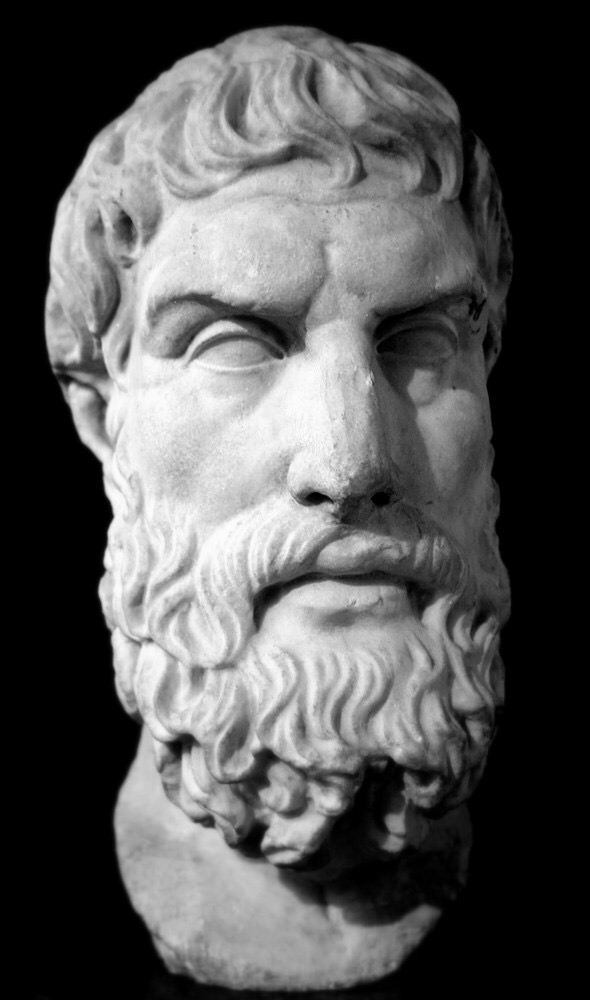
By temperament I’d probably prefer an Epicurean life. As Wikipedia has it:

For Epicurus, the purpose of philosophy was to attain the happy, tranquil life, characterized by ataraxia: peace and freedom from fear and aponia: the absence of pain and by living a self-sufficient life surrounded by friends. 

Following Alain de Botton’s lead, I think of this as seeking ‘The Garden’; an idealised  Mediterranean retreat surrounded by carefully selected friends, passing days in contemplation -with occasional breaks for olives, bread, jamon y queso and other light delights… 

But working and family life – especially the middle years – aren’t quite like that are they.

And given I’ve taken Aristotle as my guide, his ‘good life’ comes with a much higher bar; what I’ve come to think of as a life of ‘public virtue’.

Here’s a list of 11 things an Aristotelian life of public virtue requires, in a blend of my words and his; re-found last week looking at those ‘to do’ lists from 2010:

A life of Public Virtue

Courage: does my courage suitably balance fear and confidence?

Temperance: am I self-indulgent or unduly ascetic?

Liberality: am I generous, profligate or mean?

Magnificence: do I visibly give my time and money to good causes?

Pride: am I vain or unduly humble; do I step forward or stand back from noble actions and undertakings?

Honour: am I sufficiently ambitious or am I too unambitious?

Good Temper: am I good tempered, irascible or too meek?

Friendliness: am I friendly, obsequious, a flatterer or quarrelsome?

Truthfulness: am I boastful or mock-modest about my achievements?

Wit: do I sparkle or am I dull?

Friendship: am I generous in my friendship, a loner or spreading myself too thinly?

Tough tests these. 

Based on this higher Aristotelian standard, I’ve pushed myself this week: more courage, less obsequiousness and ‘mock-modesty’ – and a spot of irascibility too; telling a couple of people to b#%%€r off. 

In sum: standing for, standing against; and not just standing by on some things which need to be better.

Public virtue requires a bit of courage and a bit of oomph; a public life can’t always be a peaceful one free of fear and pain.

Good also to remember, this week of all weeks, what US ‘Founding Father’ John Adams had to say on the importance of public virtue:

Concrete or Casuistry?

img_1472

casuistry (kazjʊɪstri) noun: the resolving of moral problems by the application of theoretical rules.

As I continue my voyage through Dietrich Bonhoeffer’s Ethics, I also continue to be astonished by the man. Limpid paragraphs of dense and pure meaning, sweeping historical context – and tub thumping Christianity. A heady mix.

But the page which stuck with me this week describes the challenges of Christian ethics; but also the constant challenge of modern organisational life:

“The attempt to define that which is good once and for all has always ended in failure. Either the proposition was asserted in such general and formal terms that it retained no significance as regards its contents, or else one tried to include in it and elaborate the whole immense range of conceivable contents, and thus say in advance what would be good in every single case; this led to a casuistic system so unmanageable that it could satisfy the demands neither of general validity nor of concreteness.”

Pretty much every strategy exercise or major organisational change programme I’ve ever worked on has wrestled with this. As Bonhoeffer puts it, the conflict between the ‘good’ and the ‘real’.

Bonhoeffer argues for concrete not casuistry. Not a bad place to go, not least given how bad things were in his times. But I go with Aristotle’s ‘golden mean’; the ‘good’ is always somewhere in the difficult and constantly contested place in between.


History

The horrors of the 1930s and 40s seem far more than a lifetime away. But they aren’t. Accompanied by the flicker of black and white, the terrifying demagogues of the 20th century now seem like exaggerated fiction. But they weren’t.

In his Ethics, Dietrich Bonhoeffer describes the era:

“Rarely perhaps has any generation shown so little interest in any kind of theoretical or systematic ethics. The academic question of a system of ethics seems to be of all questions the most superfluous. 

The reason for this is not to be sought in any supposed ethical indifference on the part of our period. On the contrary it arises from the fact that our period, more than any earlier period in the history of the west, is oppressed by a superabounding reality of concrete ethical problems. 

It was otherwise when the established orders of life were still so stable as to leave room for no more than minor sins of human weakness, sins which generally remained hidden, and when the criminal was removed as abnormal from the horrified or pitying gaze of society. In these conditions ethics could be an interesting theoretical problem.

Today there are once more villains and saints, and they are not hidden from the public view. Instead of the uniform greyness of the rainy day we now have the black storm-cloud and the brilliant lightning flash. The outlines stand out with exaggerated sharpness. Reality lays itself bare. Shakespeare’s characters walk in our midst.”

But lest we be complacent about a world which seems long gone, a few pages later Bonhoeffer describes the nature of the tyrant:

“For the tyrannical despiser of men, popularity is the token of the highest love of mankind. His secret profound mistrust for all human beings he conceals behind words stolen from a true community. 

In the presence of a crowd he professes to be one of their number, and at the same time he sings his own praises with the most revolting vanity and scorns the rights of every individual. 

He thinks people stupid and they become stupid. He thinks them weak, and they become weak. He thinks them criminal and they become criminal. His most sacred earnestness is a frivolous game. His hearty and worthy solicitude is the most impudent cynicism. 

In his profound contempt for his fellow-men he seeks the favour of those he despises, and the more he does so the more certainly he promotes the deification of his own person by the mob.”

Chilling. As it was, so it threatens to be again; history has a bad habit of repeating itself if we don’t learn from it.