The Good Life

I used to be a strict Act Utilitarian – the moral act is the one that produces the most overall happiness or least harm. The undergraduate philosophy case studies all seemed clear cut to me.

Knowing what we know now, would I have assassinated Hitler in 1934? Sure would. If a sadistic Generalissimo passed me a gun to kill an innocent in exchange for the lives of several others, would I pull the trigger? Under duress and with no alternatives, reluctantly, yes.

To my untrained late-teen moral mind, rational calculations seemed to provide a better framework than the rules of religions and imperfect man-made moral codes. Undergraduate philosophy taught me how to ‘reductio ad absurdam’ any nuance or shade of grey. Life was black and white. Add it up, make the call, don’t expect to be understood, live with the consequences.

But the pointer on my my moral compass started twitching in my mid-thirties. Act Utilitarianism can feel calculating, look immoral and set bad precedents. A good outcome is a bad justification for a rotten process. Some things shouldn’t go under the wheels as we drive hard to a destination. We have to stand for some things, or we stand for nothing. Sometimes what the head can justify sickens the heart.

Enter Aristotle in my Forties. Eudaimonia, arete and telos – flourishing, excellence and fulfilling our innate potential – they feel like the ingredients of a good life to me. There are some rules and a handful of prohibitions in Aristotle’s Ethics. But ‘moderation in all things’ is the basic gist. Thinking and talking about Aristotle this week, I have a clearer idea why I prefer the life’s work of ‘eudaimonia’, to the instant gratification of ‘happiness’, as a moral end.

Happiness is a mental ‘state’. In eras where life was nasty, brutish and short it must have been pretty rare. Perhaps no surprise then that ‘happiness’ bubbled to the surface with Bentham and Mill as the ‘Dark Satanic Mills’ were robbing people of eudaimonia and the ‘telos’ of crafts and village life. William Blake, whose poems I’m reading at the moment, gives a flavour of this in ‘Songs of Innocence and Experience’.

But in the affluent, materialist, 21st century Western world, I fear happiness is a false god. Sex, drugs and rock ‘n’ roll put transitory hedonistic pleasure on an altar. Thinking about this, I was reminded of another undergraduate philosophy ‘thought experiment’ – the brain in a vat. What if all my sensations are fed me by a mad scientist thorough electrodes plugged into my brain?

Here in the ‘real’ world we are closer and closer to being able to live purely for audio-visual, digital and chemical pleasures without needing a mad scientist. People need to participate in their lives not plug in, switch off and get high. This is substantially Csikszentmihalyi’s case for embroidering our lives with varied challenges, new skills and personal growth.

Aristotle gives life an achievable and worthwhile end – to be the best of who we are. It is an optimistic, forgiving, perfectible, self-improving and thoroughly ‘open system’ – in his nutshell: ‘we are what we repeatedly do’.

Virtues and excellence grow with our actions, a little reflection and lots of practice. There’s plenty of room in Aristotle for happiness – especially through friends. There’s an explicit acknowledgement of ‘flow’ – the work of the harp player is to play the harp, and of the good harp player to play the harp well. But above all the good life is the one we lead every day by growing, improving, refining, learning, reflecting and acting.

I think Aristotle trains core moral strength better than the rational calculation of Utilitarianism. Better to act, learn, feel and constantly improve than use intellectual brute force to calculate the answers. Life is more Bayesian than arithmetic, more non-linear than deterministic. It’s a life’s work to work on the answers for myself – and to enjoy the journey.
Broadband

Our home broadband has been on the blink this week. You really miss it when it’s not there. Perhaps worse is when it comes and goes – one minute you’re surfing gaily, the next you’re beached with a ‘no network’ message.

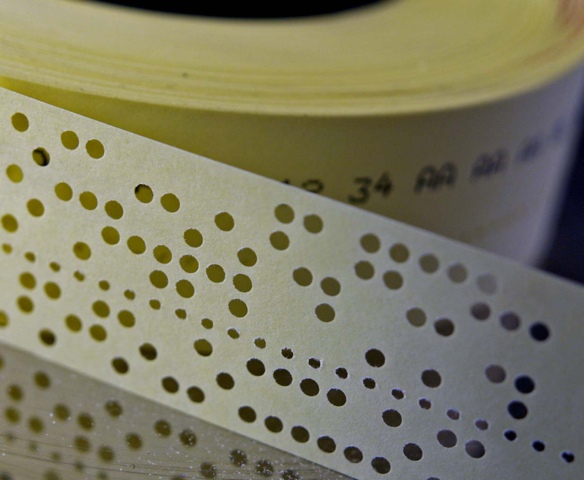
Csikszentmihalyi points out that, although impressive by electronic standards, the amount of data our minds can process simultaneously is surprisingly small. More punched tape than broadband. Two people talking to us at once or, say, riding a bike and whistling a song, just about exhausts our real time mental processing capacity. Any more and we lose attention and get distracted, flustered or confused.

I noticed it one day this week in the office. One minute I was churning out flowing prose, the next someone started talking in my earshot and I was distracted. I slowed to trickle – like someone was hogging my wifi. The talker left, bandwidth returned, and so did flowing prose. It was like flipping a switch.

Things, events, people and basic navigation are all basically different data and signals crowding in or cluttering up our cognitive bandwidth. This makes directing our consciousness and limited mental energy hard.

And it’s especially hard because life can easily just happen to us. Events and other people can readily soak up all the bandwidth we have. And if we do decide to use that precious resource on directed thought and action, we do so against a background of almost overwhelming distraction and diversions.

All life is, is the continual stream of sensory data, words, pictures, thoughts and ideas streaming through that narrow mental bandwidth. All we are, is the accumulated store of that data in the limited hard drives of our brains and to some extent those of others. It makes you think – until someone starts talking in your earshot and the mental connection is interrupted.

But given mental broadband is always there I’ve discovered I can redirect it when I catch myself wasting or underusing it. At work this week while being gently bored by a presenter on pan-European data collection standards, I contemplated the extraordinary beauty of a large tree – spare broadband successfully redeployed into joyful contemplation.

More experimental was testing optimising ‘flow’ by doing two different things simultaneously, and well. Combining loudly whistling the Marseillaise with cycling to work smoothly and safely through London traffic perfectly occupied my mental broadband. And in a heartily enjoyable way. Vive la France.

Our mental broadband has surprisingly limited peak capacity. But the compensation is it is ‘always on’. You can waste it or have it used for you, but you can also use it well. I found this week being more careful in how I deploy my personal ‘punched tape’ makes a big difference. Focusing its use on doing one or two things at a time really well – and exploiting every minute of it – whether I’m on my own, or with others, has removed a good deal of routine boredom and irritation from my week. Replacing that with moments of joy, satisfaction and genuine happiness is broadband well spent.

Waste not, want not.

Immersion

Concentrating on boiling a ham on the hob yesterday, I was reminded of a key aspect of ‘flow’ – immersion. ‘Flow’ is ceasing to be self-conscious or unduly conscious of others and becoming thoroughly immersed in the task or activity.

When you look at it this way, a number of things we usually consider important in enjoyable achievement turn out not to be – notably the immediate judgement and appreciation of others. Also, a variety of things we consider dull can suddenly become a joy.

Take hoovering the house. Usually a chore, and one I resent. I enter into it – if at all – with little a priori enthusiasm. I have, however, discovered it passes more easily with an iPod, headphones and music.

Surprising then to discover last weekend during a particularly energetic and virtuoso vacuum – as I removed the ‘T head’ to more precisely target the skirting boards in the kitchen – I was in full ‘flow’. It was an absorbing task, in which my goal was evident, feedback clear (disappearing crumbs and detritus) and my mental energy was fully absorbed (in music and coordinated physical effort). Stone me, it’s that simple I realised.

I was talking to another parent yesterday about how this applies to kids, sports and music. The art is perhaps in helping a child to become completely immersed in the ‘process’ of playing football or the piano to the point they cease to be self-conscious or unduly conscious of you and your anxiety/impatience/projection of your own hopes and fears (delete as applicable).

A lot of what we do with children and activities is the opposite. We make them concentrate on us, keep pushing them on – before they’ve had time to master or enjoy developing skills – and most of all we distract them with incentives and threats. The art of ‘flow’ is to let them lose themselves in what they are doing and forget we’re there – not focus them on extrinsic rewards or punishments.

More immersion perhaps means less coercion. And letting go a bit and getting lost in what they’re doing makes parenting ‘flow’ more easily too.

Marseillaise

Reading Csikszentmihalyi on a family Bank Holiday in sunny France, I was reminded of the tyranny of progress and performance. 

Not that it was Csikszentmihalyi’s fault. We’d been talking with friends the night before going away about learning musical instruments and the merits of lessons and regular practice. 

Now I firmly believe that the best way to improve at anything is to practice regularly – the action of water on a stone is gradual, but inexorable. I have also learnt that the best way to practice anything regularly is to integrate it your daily routine. The problem is there are only so many hours in the day. What to do? More, less often?

I remember from my time working in advertising in France in the 1990s that people have predictable daily and weekly habits. But we do not generally form monthly habits and signally fail to form fortnightly habits. This gave rise to the unspoken rule, never buy an an Ad next to a monthly or worse a fortnightly TV show – they never pull in a regular audience and generally fail. Even if they are well liked once, people forget to tune in ever again. We are creatures of routine.

So where does that leave us with practice, hobbies and busy lives. My conclusion is the only practical options are dedicating daily or weekly slots. My daily slots are all pretty much full: kids, work, kids, eat, dishwasher, potter briefly, bed. 

The brief evening pottering – which recently was when I walked our ageing dog – is the remaining ‘purposeable’ slot. But a few minutes spinning the wheels, albeit aimlessly, seems a very small concession to relaxation. It’d take something ‘light’ and ‘fun’ to fit in edgeways in that small nook in a way that didn’t feel like a chore. 

The ukulele used to be that thing. And for nearly a year I played five songs nearly every night and went from hopeless and tuneless to strumming comparatively competently. Then the dog got incontinent and the habit got broken. So I could go back to the uke. But here’s where the tyranny of progress kicks in. Our friends feel I should have lessons, improve, look to play publicly or at least in private duets and preferably drop the four strings and migrate to a proper six string guitar. 

Phew. Where’s the eudaimonia in all that – the pressure to rapidly improve my skill to meet the challenge of musical excellence feels most unappealing. I said ‘no thanks’. They looked at me like I was mad – what’s the point of strumming the same five songs and never playing them with, or for, someone. Where’s the progress, where’s the performance. The point though – I think – is I quite enjoy it as a personal exercise for me, for ten minutes at night. The simple challenge I set myself is met by my rudimentary and very slowly improving strumming skill: producing modest, low-impact, private, musical ‘flow’.

Separately, on hols I was congratulated twice on my French – one woman said “Vous parlez très très bien Monsieur”. Another asked me if I was a French teacher in England. 

I had given up keeping up my French. I’d given up listening to ‘intermediate French’ audio magazines I subscribed to when I first came back from France. There were no opportunities to match my once reasonable skill with any worthwhile challenge at home. Talking about nothing much in French, just to speak French, seemed pretty pointless. And over time I felt myself going backwards which made matters worse.

But ‘flow’ in French has returned. Family holidays now provide me the perfect opportunity to navigate the modest but important challenges of travelling, accommodating, feeding and entertaining my little family. And they seem quietly impressed and genuinely grateful for my efforts. Now I have a stage on which to perform, some modest (daily?) investment in progress and improvement suddenly seems worthwhile – I’ll be looking at what the web has to offer for ‘intermediate French’ these days.

‘Flow’, progress and performance are closely intertwined, so much Csikszentmihalyi amply demonstrates. But I conclude the recipe and mix aren’t always the same. There are things we do well, some we may do very well and many we could do better. I believe good day-to-day ‘flow’ lies in accepting that not everything we do has to be excelled at. Sometimes the only audience that matters is ourselves. 

Fluid Dynamics

A good friend put me onto the ‘flow’ psychology of Mihaly Csikszentmihalyi. As is not uncommon with names with unfamiliar spellings, it’s easy to glide over Csikszentmihalyi in text while subconsciously logging him as unpronounceable. But if you are going to commend him to others it’s good to get your mouth round his name. Broken up it’s not so hard ‘Chick-sent-me-hi-yee’. And there is modest satisfaction to be had in mastering the unpronounceable – a theme I will return to…

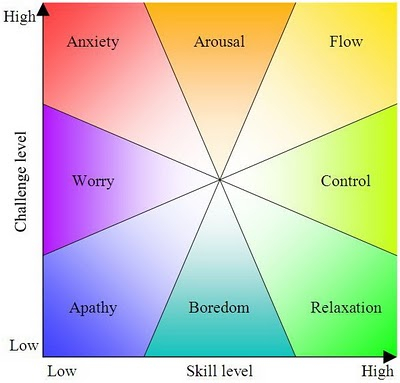
Csikszentmihalyi’s thesis is beguilingly simple. ‘Flow’ is the exhilarating feeling of meeting ‘high challenge’ with ‘high skill’. When challenge is low, and our skills are too, we slump into boredom and apathy. When challenge is too high we suffer worry and anxiety. Where our skills comfortably exceed our challenges we are relaxed or in control. When a challenge threatens to stretch us we are alert and ‘aroused’. Finally, ‘flow’ is that feeling of achievement, fulfilment and flourishing which comes with doing a difficult thing well.

In the classic ‘flow’ diagram (above), there are eight segments: control, relaxation, boredom, apathy, worry, anxiety, arousal and ‘flow’ with a point of intersection in the middle. Some people add a ‘subject mean’ as a central zone around the point of intersection which is our personal average zone for a given activity or situation.

When I first looked at one of these diagrams I more or less cottoned on to the eight segments. But I couldn’t decide what to make of the point of intersection – is it a good place? Or a bad place? Or is it a completely neutral place?

Over last weekend, playing football, then watching it, a children’s film, my mother and thinking about ageing bodies and minds, I conclude the ‘subject mean’ or ‘point of intersection’ is a moveable feast. And therein lies the rub, it seems to me. With ‘flow’, the goalposts are constantly moving – and not just one way.

How so? One of the great lessons of adult life is that aptitude usually comes a poor second to application and practice. Almost everything gets easier with practice. Equally, no-one from Einstein to Nijinsky achieved great skill without hours and hours (or if you believe Malcolm Gladwell more or less 10,000 hours) of practice. Watching my kids trying new things they readily assume – as I did when I was young – that they are ‘good’ or ‘bad’ at something due to early luck or accidents of fate.

Certainly some kids learn faster than others, some are more physical some have greater dexterity. But like everything with nature and nurture, these basic skills and aptitudes are developed or not developed by the hours spent at a blackboard, in ballet shoes… or in football boots.

On Saturday I was kicking a football about with my son. I was a decent footballer in my day, but very one footed. No left peg. But trying it, within the space of a dozen passes concentrating uniquely on using my left foot, I went from feeling completely off balance to passing comparatively cleanly, crisply and accurately. Not exactly ‘flow’, but some ‘arousal’ and less ‘anxiety’ than the first clumsy attempt. My point of equilibrium had shifted a little.

Later in the day, I watched one of the most talented midfielders of the last 15 years demonstrate the opposite. Paul Scholes saw red in the all Manchester FA Cup Semi-Final at Wembley. A lunging high tackle earned him a sending off. His immensely gifted feet, and the quickness to single-handedly turn a game, now were fractionally too slow to ‘flow’ at the highest level. He was ‘aroused’ to futile anger instead.

From a footballer’s inexorable decline, to the sad story of 1970s Prime Minister Harold Wilson which preys on my mind from time to time. We all hope that when the body falters the mind will stay sharp. Poor Harold Wilson, who went to the same Oxford College as me, was allegedly the first to realise his hitherto razor sharp brain was slipping. He felt the need to resign quickly before anyone else noticed. From Paul Scholes and Harold Wilson I infer our ability to ‘flow’ can diminish with physical and mental decline – and our ability to cope with it too.

But perhaps inexorable decline is not the way to think about ‘flow’. Watching my mother play with my kids on Sunday, she showed them a yoga stretch which her yoga teacher recently described as ‘awesome’. She won her first ever lawn bowls team trophy last year and took the individual ladies prize this year. She is 67. Perhaps we need to be kind to ourselves and move our interests and our ‘mean points’ so we don’t lose our own joy as we age. I think of this on my bike some days when cycling to work feels like a chore. In a decade or two I will dream of the physicality and strength I take completely for granted in those moments. It changes my perspective.

But even if we are kind to ourselves over the long haul, finding ‘flow’ every day is a new challenge each and every day. On Saturday morning I watched ‘Night at the Museum’ with my boy. It’s a jolly Ben Siller romp in a New York museum where all the exhibits come to life and brawl with each other at night. It’s my son’s current favourite. As with so many of the US kids genre, there are plenty of worthwhile homilies and invariably a good moral to the story.

After twists and turns and trials and tribulations this one ends with father and son reunited and Attilla the Hun, Christopher Columbus and assorted cowboys, animals, Romans and great Americans dancing together in one big non-alcoholic all night party. The moral of the story? If we all pull together, everyone can get along. But in the real world, once the ‘flow’ of a romping script’s worth of challenges had been briefly toasted, they’d all have been ‘bored’ and ‘apathetic’ by morning – and fighting again the following night. With ‘flow’, unlike fairy stories, there are no “happily ever afters”. Every day needs filling. No challenge, no ‘flow’.

So Csikszentmihalyi’s ‘flow’ is both blessing and curse – like Aristotle’s Eudaimonia, it’s a life’s work, and there is no easy solution. To paraphrase Csikszentmihalyi himself: life is “what we experience from morning to night, seven days a week, for about seventy years if we are lucky, for even longer if we are very fortunate… there are no gimmicks, no easy shortcuts. It takes a total commitment to a fully experienced life, one in which no opportunities are left unexplored and no potential undeveloped, to achieve excellence.”

So every day, whether it’s kicking a ball with my left foot, unevenly strumming a ukulele or lashing together another blog post, all are opportunities to ‘flow’. The art of ‘flow’, I think, is recognising it is there to be had in small things as well as large, in things we are objectively very ‘good’ at. But also in things we aren’t but are prepared to give a try.

And if ‘flow’ is an internal ‘feeling’ then we substantially have the power to judge it and feel it for ourselves. So I’ve decided the art is in choosing well the things we invest time in doing, being kind to ourselves in setting the bar and not being too hard on ourselves as we progress. Like a personal pacemaker in our own race of life, ‘flow’ runs only as fast and as far ahead of us as we let it.