To infinity and beyond…


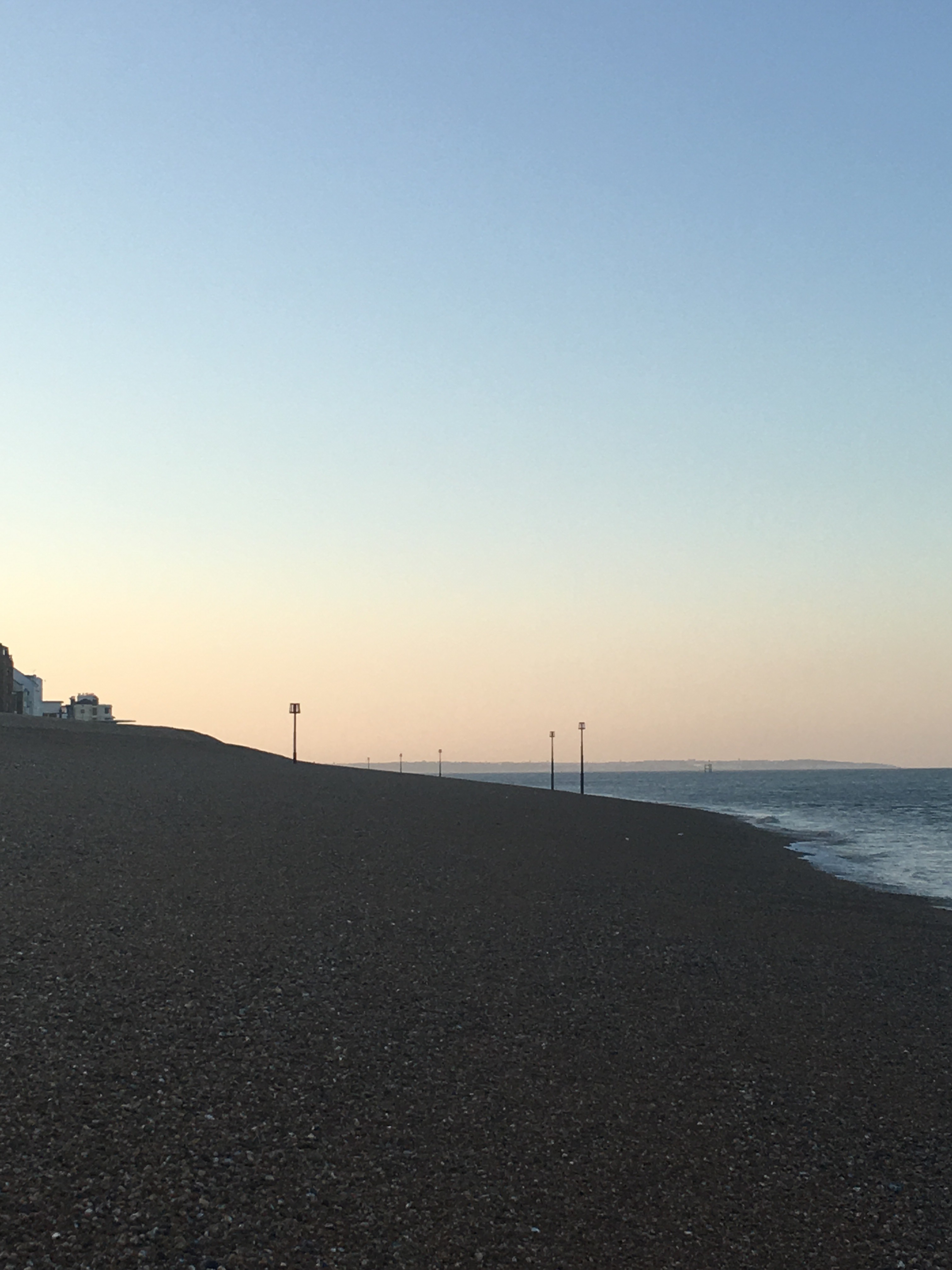
Last weekend at twilight by the seaside, I took this photo. 

It picks up a theme I’m reading about at the moment; which is getting into the habit of looking a little beyond what’s happening right in front of you. 

Simple really – look up… 

Urban life is so full of people, noise, distractions, aggro, interruptions, obstacles and incidents. But if you look up at the sky or the far horizon they all melt away. 

It’s a clever trick… As we were driving to the seaside a football flew out of a local park and slapped hard into the side of the car with a very loud thud. Just a quick look at the clouds and the moment had gone…

This is not an argument for indifference or distraction – quite the contrary. When you look up you see things: trees, clouds, birds, fine rooflines, planes; or sometimes just the limitless sky, which expands into the boundless upper atmosphere and on to the unending universe. 

It’s simply that when you look up; it’s almost impossible to feel down. 

Everybody’s talkin’ at me…

I sat through nearly two days of interviews this week. And, as so often, was amazed by how much people like to talk – and what they shared! 

Surely the most valuable thing to learn in life (and certainly in interviews) is that the most important and influential thing you can ever do is stop talking; all the time you’re talking, you’re basically draining the interview panel’s energy away!

We all want to talk; but if you want to get a job, in the words of the otherwise flawed Aaron Burr, from the wonderful Broadway musical ‘Hamilton

“Talk less; smile more…”

Smile, surf, sleep

Smile

Talking to my daughter about her friendship angst this morning, I advocated she try a welcoming smile. 

I told her about the nice lady at work who told me about the cold snap in Romania and how it’s threatening the cherry trees; people are tending fires to gently waft smoke through the branches to protect the cherries. We both wished them well.

This lovely encounter grew from simply smiling, on three occasions as she made me a latte; and the smile developed into an exchange and then a conversation. 

Let’s see how my eldest gets on – I suspect it might take me than a smile with this ‘friend’.

Surf

I’m reading a rather terrific book about letting go of anxiety and fear and tapping into your own energy. 

More of this anon, but one of the many useful reminders is nearly everything that happens to us, in truth, is outside of our control. This means there are only two options, try to resist, control or avoid life – or roll with it. 

This week (like so many) looked on Tuesday morning (after an enjoyable but tiring bank holiday) like wave after wave of bother, problems, egos, unreasonable demands, risks and stressors; culminating in large forum event – at which I would have to orchestrate, perform and keep the whole show together. 

So it was; but by (largely) surfing along on the top of it all and not fighting it (and myself) I got through it just fine. By saving the energy on worry, avoidance and fear – I got it all done quite happily. 

As King Canute amply showed, there’s little point trying to stop the waves; may as well get up on your board and ride ’em.


Sleep

My old friend sleep. I need it so much, I never get enough of it and I never do enough to make sure I do. But I have improved in a few areas… to earplugs I’ve added eyepatches and from last week a booze curfew at 9pm. 

All the book and all the sage advice in them can’t help me when I’m tired. Without my sleep I’m hopeless; with it I’m smiling and surfing along.

Confrontation and Compassion

Compassion came up a number of times this week – on Tuesday in the context of confrontation; and yesterday as a way to run an entire organisation. Of course the Dalai Lama and Archbishop Desmond Tutu would argue (in the book I’m reading below) that compassion is what we should use to run the entire world.

Back to confrontation through – a colleague of mine was arguing for a ‘public hanging’ to show that the behaviour of some people will no longer be tolerated. I said I felt not; I was accused of appeasement. 

That stung a bit, but my considered counter was: when I’ve ‘gone to war’ with people at work all manner of ills have followed – for me, them and everyone around us. 

So I offered what The Book of Joy suggests instead:

“There is an important distinction between forgiveness and simply allowing others’ wrongdoing. Sometimes people misunderstand and think forgiveness means you accept or approve of wrongdoing. No, this is not the case. We must make an important distinction.” The Dalai Lama was speaking emphatically, striking on hand against the other. “The actor and the action, or the person and what he has done. Where the wrong action is concerned, it may be necessary to take appropriate counteraction to stop it. Towards the actor, or the person, however you can choose not to develop anger and hatred. This is where the power of forgiveness lies – not losing sight of the humanity of the person while responding to the wrong with clarity and firmness. 

This is easier to say than do – both ways. I sometimes find it hard to respond quickly to a ‘wrong’ with ‘clarity and firmness’ without drawing on anger; and once the incident has passed, it feels like I’ve missed the moment and the best thing is probably to move on. But the Dalai Lama invites me to do better: 

“We stand firm against the wrong not only to protect those who are being harmed but also to protect the person who is harming others, because eventually they, too, will suffer. So it’s out of a sense of concern for their own long term well-being that we stop their wrongdoing… We do not let anger and negative feelings develop, but we strongly oppose their actions.”

Desmond Tutu sets out the personal benefit of forgiveness, which I buy completely and have experienced fully in recent years: 

“Forgiveness is the only way to heal ourselves and be free from the past. Without forgiveness, we remain tethered to the person who harmed us. We are bound to the chains of bitterness, tied together, trapped. Until we can forgive the person who harmed us, that person will hold the keys to our happiness, that person will be our jailor. When we forgive, we take back control of our own fate and feelings. We become our own liberator.”

The Dalai Lama picks up: 

“So it is totally wrong,” he said emphatically, cutting his hand sharply through the air, “to say that practice of tolerance and practice of forgiveness are signs of weakness. Totally wrong. Hundred percent wrong. Thousand percent wrong. Forgiveness is a sign of strength.”

The Archbishop adds with a laugh: 

“Those who say forgiveness is a sign of weakness haven’t tried it.”

Forgiveness I have largely cracked. Responding to ‘wrongs’ with ‘clarity and firmness’ but without hot or cold anger… that is a work in progress.
Joy

The rather wonderful Disney kids film ‘Inside Out’ suggests the eponymous ‘Joy’ (above) represents our original childlike state. In the film, the loss of ‘Joy’ deep into the vaults of memory is the bridge to the discovery of the more complex emotions of teen and adult years. 

It’s a lovely film. From our family watching experience, it helps both kids and adults better understand their emotions and personalities.

Interesting then – at the other end of life – to read two famous eighty year olds advocating the same simple emotion. The Dalai Lama and Archbishop Desmond Tutu invite us to do better than ‘happiness’: a rather stolid state of satisfaction; and aim for ‘joy’. 

So what makes for joy? Here’s what The Book of Joy says:

Our ability to cultivate joy has not been scientifically studied as thoroughly as out ability to cultivate happiness. In 1978 psychologists Philip Brickman, Dan Coates and Ronnie Janoff-Bulman published a landmark study that found that lottery winners were not significantly happier than those who had been paralysed in an accident. From this and subsequent work came the idea that have a “set point” that determines their happiness over the course of their life. In other words, we get accustomed to any new situation and inevitably return to our general state of happiness. 

I’ve read this before and there’s good and bad in it, I think. It helps with resilience as you know you’ll get through stuff, but doesn’t lead to much hope for joy; whatever you do you’ll just default back to ‘average’ happiness… But the next para is VERY encouraging:

However, more recent research by psychologist Sonja Lyubomirsky suggests that perhaps only 50% of our happiness is determined by immutable factors like our genes or temperament, our “set point.” The other half is decided by a combination of our circumstances, over which we may have very limited control, and our attitudes and actions, over which we have a great deal of control. According to Lyubomirsky, the three factors that seem to have the greatest influence on increasing our happiness are: 

  1. Our ability to reframe our situation more positively
  2. Our ability to experience gratitude
  3. Our choice to be kind and generous

These are exactly the attitudes and actions that the Dalai Lama and the Archbishop had already mentioned as central pillars of joy.

I realise looking at them that I really started making headway on the three factors in joy in my early forties – not the least through reading and blogging. 

As the saying goes ‘life begins at forty’. Perhaps if you’re lucky the rediscovery of ‘joy’ begins too.