
Writing

Here’s to Eric Barker, who more than once has put me on a better track. His weekly writings are well worth signing up for here in my humble opinion.
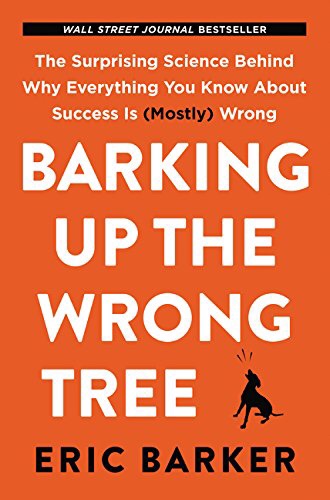
He’s given me a handy reminder that apart from anything else, there are good mental health reasons for writing stuff down:

We ruminate endlessly but that just makes things worse. When you’re merely thinking about your problems, you hop, skip and jump all over the place, never resolving one issue before moving on to the next. Writing forces us to put a structure around life. To make sense of it.

And it’s not just about venting:

The effects were not due to simple catharsis or the venting of pent-up emotions. In fact, the people who just blew off steam by venting their feelings without any thoughtful analysis tended to fare worse…Talking or writing about the source of our problems without self-reflection merely adds to our distress…

Writing is about codifying and coming to a deeper understanding…

The authors asked students to write about their thoughts and feelings about their lives. Those who showed more deep-level thinking along with constructive problem solving were less depressed later and had fewer health care visits. Those students who merely expressed their emotions and described their anxiety had more health care visits…

A large number of good scientific studies conclude that the mere expression of emotion is usually not beneficial on its own. Rather, people typically must learn to recognize and identify their emotional reactions to events.

In effect:

Once you understand something, once you can find a place for it in the story of your life, that’s when you can put it behind you and move on.

And, that’s just one of the many reasons it seems to me (and to science) that regular writing is so important…

Here’s where the some of the science comes from:

More than thirty years ago there was a guy named Jamie, his marriage was in the toilet, and he was utterly depressed. Despite having big problems, he didn’t go to a therapist. (Which is ironic because Jamie was a graduate student in psychology, of all things.)

Instead he started writing. A lot. He wrote about his marriage, his career, his childhood. He basically covered every serious issue in his life and how he felt about it. And then something happened… He felt better. A lot better. And he realized how much his wife meant to him. They resolved their issues. Then he had a thought:

“Maybe writing might help anyone feel better about their struggles in life.

And being a psychology grad student, he did a study to test the theory… And he was right. Since that first paper was published in 1986 hundreds of other studies have shown the power of expressive writing to help people. In the thirty-plus years since, many students on the University of Texas at Austin campus have come up to Professor James Pennebaker and said:

“You don’t remember me, but I was in your experiment a year ago. I just wanted to thank you. It changed my life.”

James Pennebaker is the Regents Centennial Professor of Psychology at the University of Texas at Austin. 

Pennebaker’s book is: “Opening Up by Writing It Down: How Expressive Writing Improves Health and Eases Emotional Pain”
Keep on rollin’

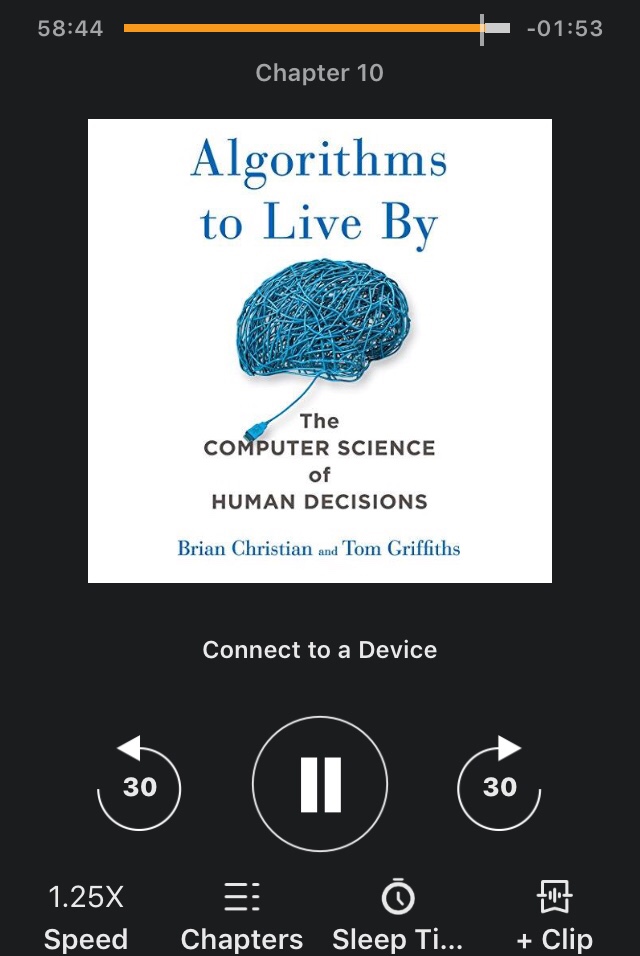
Attracted by algorithms some while back, I bought myself this audiobook… it sounded like exactly what I was looking for:

I found it hard going if I’m honest. Listening at 1.25x speed helped.

But while the ‘optimisation problems’ of public parking turned out to be vaguely useful at work, my heart sank a bit the other Saturday when rolling the ‘relevant complexity’ dice served up the answer: ‘Audiobook’…

…Ho hum. But you have to trust the dice.

And sure enough ‘Algorithms to live by’ proved the point; the chapter on ‘Randomness’ validates a lot of what I’ve been trying recently:

Recent work in computer science has shown that there are cases where randomized algorithms can produce good approximate answers to difficult questions faster than all known deterministic algorithms.

One problem they help with is ‘Hill climbing’ and local maxima.

At any point in life – however much you’ve perfected it, the risk is it could still be better. Like a climber in the mist, you know you’re in a good place – but there might be an even better one you can’t see for the fog.

And randomness is the way to find out.

Try something a bit different and you can find out whether you’re at the top of a small hill of possibilities – or surveying the entire range from the highest vantage point.

The truth of life is: you never can know if you’re stuck in a local maximum. But the odd throw of the dice now has the full weight of computer science behind it!

Keep on rollin!

Happy Tracks II

Has anyone else in the entire world got a playlist with Tom Jones, Vic Reeves, The Bee Gees, Bass-O-Matic and The Skids in it?

I’d be surprised.

But that’s the joy of Spotify – it learns what you like.

Every Monday the ‘Discover Weekly’ playlist serves up more songs like the ones I’ve ‘liked’ before, and the number and variety of my ‘Happy Tracks’ just gets bigger and bigger.

It has become a standing joke in the car with the kids; my Happy Tracks are frequently unlistenable to younger ears. But they get me toe tapping and steering wheel slapping.

Of course there must be a natural limit – I’m up to 504 songs now in less than a year – and growing steadily. Plus we know that learning algorithms drive ads, monetisation and ‘fake news’.

My original Happy Tracks were assembled by me – now a computer does it. That can’t be all good.

But sometimes you just have to know when you’re beat. Months ago I bought a book on computer science and algorithms to see if I could do exactly this: train an algorithm to serve up my taste in music, art and writing… And then I realised that’s exactly what search engines and social media firms are doing… doh!

Still you can’t be too happy. And Happy Tracks simply puts me in a better mood every time I put my headphones on.

So here’s to artificial intelligence – and stupidity – because Spotify is smart enough to come up with enough duds to kid me I still have superior taste!

Diced Relevant-Complexity

Having codified it three years ago, I amply proved the central premise of relevantcomplexity.com:

“But then, subtly and imperceptibly, sometimes even the things we once enjoyed the most, tail off into familiarity, boredom and ennui.”

I got bored of it.

Thanks goodness for Sonja Lyubomorsky… in the How of Happiness (which is also a website here) she sets out compelling evidence for two things which have really helped me this winter:

1) Hedonic Adaptation: pretty much anything which happens in your life – house move, significant gain or loss, any purchase from car to Concorde – you will have adapted to within three months; and then very importantly…

2) Happiness Set Point: you always return, inexorably, to your genetically determined default happiness setting; as proven by identical and non-identical twin studies. If you’re a miserable so and so, you likely always will be; if you’re a ray of sunlight, the same. Identical twins separated – with completely different life circumstances – have almost identical happiness levels. Non-identical twins living near identical lives, have widely divergent default happiness levels.

This sounds like a recipe for Stoicism (of which more anon). But the good news is you can better your Happiness Set Point – not by getting a better job, car or house… but by tricking yourself. The only way to beat your Happiness Set Point is to catch yourself out!

This explains (and links) my experience with Relevant Complexity and Csikszentmihalyi’s “Flow”. My Happiness Set Point is a comparatively gloomy one. I was (initially) enjoying Relevant Complexity because of the variety and novelty. Then Hedonic Adaptation kicked in, “flow” went away – and inexorably and inevitably like a Newton’s Cradle I returned to my default ‘same old same old’ Happiness Set Point and lost enthusiasm for Relevant Complexity.

But now I’m back! The secret? Dice…

As Sonja Lyubomirsky sets out, the key is to trick yourself. So now I have dice and lists. When I’m pottering in the kitchen: the dice decide whether I’ll listen to a podcast, an audio book, the news in Italian, classical music, 80s hits, footie or talk radio. And each time I get bored; simple – roll again.

Similarly in a morning instead of fighting the randomness of which bus arrives first (and it’s never the one I want) I’m just hopping on. Make some progress, watch the world go by and change where there are more options. Embracing – even imposing – randomness seems to brighten up both me and my day. And it has certainly got me back doing the Relevant Complexity thing again.

But I’m not kidding myself… I’ve got three months before I have to come up with something new; you can’t cheat Hedonic Adaptation and your Happiness Set Point for long!

Distracted? There’s an App for that…

Eric Barker writes a great blog; I’ve told three people about the thesis in this post, in the last week or so.

Neuroscience increasingly suggests we’re all more a bunch of impulsive Apps than a well designed rational operating system.

Makes a lot of sense to me; and has reminded me to actually make a bit of time for mindfulness for a week or two – as opposed to reading about it, avoiding it and constantly distracting myself by doing other things. Let’s see how I get on…

“The human brain wasn’t built top to bottom as a single project like Apple builds a computer. It evolved over millions of years in a very messy fashion. Various systems (or “modules”) came about to drive you to accomplish different tasks like seeking food, fighting, reproduction, etc. But here’s the problem…

They were never integrated. So these systems compete to steer the ship that is your brain. Your mind is less like a single computer operating system and more like a collection of smartphone apps where only one can be open and running at a time.

Here’s noted science author Robert Wright:

In this view, your mind is composed of lots of specialized modules—modules for sizing up situations and reacting to them—and it’s the interplay among these modules that shapes your behavior. And much of this interplay happens without conscious awareness on your part. The modular model of the mind, though still young and not fully fleshed out, holds a lot of promise. For starters, it makes sense in terms of evolution: the mind got built bit by bit, chunk by chunk, and as our species encountered new challenges, new chunks would have been added. As we’ll see, this model also helps make sense of some of life’s great internal conflicts, such as whether to cheat on your spouse, whether to take addictive drugs, and whether to eat another powdered-sugar doughnut.

Now modules aren’t physical structures in the brain, just like apps aren’t hardware in your phone. They’re software; the human nature algorithms that Mother Nature coded over thousands of generations of evolution.

So you want to diet but you see donuts and your brain’s hunger module (like the “Grubhub” app) hjacks control and says, “Food! Eat it. Now.” Or you want to be nice but your mind’s anger app (“Angry Birds”) takes charge and you’re saying things another app is really going to regret tomorrow. You’re like a walking live performance of Pixar’s “Inside Out.”

So how do we prevent hijacking by the wrong module at the wrong time and make better decisions? First we need to learn how those inappropriate modules get hold of your steering wheel…

Feelings. Nothing More Than Feelings.

Whichever module has the most emotional kick attached to it at any point wins the competition to be “you.”

Under this lens, many of the confusing and frustrating things about human behavior start to make a lot of sense:

  • Of course people are hypocritical. They’re made up of competing “selves” with very different goals and different information. Uncle Al is the most reasonable guy in the world — unless his “politics module” takes charge.

  • Are people good or bad? They’re both. The metaphorical angel on one shoulder and devil on the other are just different modules in the brain with different motivations.

  • Why do you lack self-control? Because now the word doesn’t make any sense. It’s actually “selves-control.” Your behavior isn’t inconsistent; the “you” in charge is inconsistent.

Here’s University of Pennsylvania psychology professor Robert Kurzban:

Some modules are designed to gather benefits, others are designed to deliver benefits, and they exist in the same head, sometimes in conflict. In the same way, this analysis does away with the question of whether individual acts are “really” self-interested. Different kinds of acts advance the goals that some, but not other, modules are designed to bring about. So, both meanings of “self-interest” seem to be a problem because different modules have different designs, and are therefore built to bring about different outcomes.

Here’s Robert Wright:

The human brain is a machine designed by natural selection to respond in pretty reflexive fashion to the sensory input impinging on it. It is designed, in a certain sense, to be controlled by that input. And a key cog in the machinery of control is the feelings that arise in response to the input. If you interact with those feelings… via the natural, reflexive thirst for the pleasant feelings and the natural, reflexive aversion to the unpleasant feelings—you will continue to be controlled by the world around you.

How To Prevent Brain Hijack

Buddhism recognized this problem over 1000 years ago. And it also came up with a solution: mindfulness meditation.

And neuroscience gives it a big thumbs up. Studies show meditation trains your brain to be less reactive to emotional swings and can prevent the wrong module from hijacking control of your brain.