Obscurantism

/home/wpcom/public_html/wp-content/blogs.dir/509/15823857/files/2014/12/img_3202.jpg

I congratulated a colleague yesterday on some lovely prose. His concise, interesting and informative writing made me happily read about 80 Moments which changed history – learning a lot in the process.

This morning, I read another piece of quasi-Academic writing; but which was much more of a slog. It was saying some important things, but in a rather portentous – even pretentious style. The few key points, could have been made a lot more simply.

Then, by happenstance I moved onto to a super article on ‘Obscurantism’ in the equally super Philosophy Now magazine. The question it poses is: when is being complex and hard to decode legitimate, useful; even necessary – and when is it plain unhelpful.

Here’s some of what Siobhan Lyons has to say:

‘Obscurantism’ can indeed be an effective manoeuvre, provoking greater thought-processes and intellectual investigation.

This couldn’t be illustrated more clearly than in Rembrandt’s The Holy Family with a Curtain (1646). I am less concerned with the religious meanings of this painting than I am about the curtain itself; a seemingly innocuous, pointless part of the work, and yet it provokes the viewer to wonder what lies behind it.

The curtain, blood red and purposefully pulled partly to the side, teases the viewer, offering not even a partial glimpse of what it completely obscures. The Virgin is plainly seen; and there is Joseph, semi-obscured in the background, near the curtain; but whatever is behind the curtain itself is left unanswered.

The painting thus features three forms of creative depiction: the Virgin’s clear visibility, Joseph’s semi-obscured form, and the curtain itself, a symbol of obscurantism, or rather, of the ability of obscurity to be creative, by emphasising the ambiguity that so often confronts us, which may however be the source of great art, and indeed philosophy.

For the greatest philosophies are aware of their own limits – aware of when they cannot answer the questions their philosophers ask. As Wittgenstein stated, language must be beset by certain limits.

So obscurity in language can be seen as not always self-defeating, but, ironically, as sometimes illuminating. Moreover, if language were a purely functional tool for communication, we would cease to have literature as we understand it.

If all curtains in all art were pulled completely aside to expose what lies behind them, then the need for imagination would deteriorate. This also explains why good writers are those who not only have a masterful grasp of language, but who also know how to pull it apart and put it back together in different ways.

Nicely put. Not everything in life, thought or Art can be expressed simply; and some things can’t be expressed at all. The art is in knowing which. But also, I think, in having a try. Only practice makes more perfect.

The Lost Jockey

IMG_3184-0.PNG

This week, I have adopted Magritte’s ‘Lost Jockey‘; I found him a home on my iPhone ‘lock’ screen.

Painted in 1948, the ‘Le jockey perdu‘ has lost his racetrack and is charging through an other-wordly sepia forest.

“Racing nowhere fast”, is what the jockey says to me. And that’s why I put him on my home screen. Sometimes I do things faster that than I should. Sometimes I try to do tomorrow’s work today. Sometimes I do good things, but don’t take the moment to enjoy them.

The jockey – whom I have to swipe with my thumb, to open up the brightly lit iPhone world of action, reaction, email, work, stimulation, art, literature, music, aggro and time commitments – has reminded me several times this week not to ‘swipe’ – just do the thing I’m doing; not start something else.

IMG_3177-0.PNG

Mighty; Fallen

IMG_3157.JPG

Scooting along – reminding myself that whatever else may be wrong, fitness and health are one thing I can be proud of. Then, BANG!

Ooof, skinned palms, knees and blood-dripping chin; hands not working and a limp, bent and seemingly useless right arm. In an instant broken, bloody, battered and hurting.

It’s all got slowly better. But last Saturday, I literally couldn’t fork my wallet out of my pocket, get a shirt over my head or do up my own buttons. The simplest things – the kettle, doors, even sleep, all too hard.

A painful reminder that past 40 you don’t bounce, you crumple.

I have been slow, laboured, distracted and reduced – spending the week trying to warn (and avoid) people who wanted to vigorously shake the limp hand, of my slowly straightening right arm.

Take care of these bones, I conclude. Keeping a happy head has been very hard; without a happy body to carry it around. Health and fitness are a gift, not an entitlement.

A Different Perspective

IMG_3150.JPG

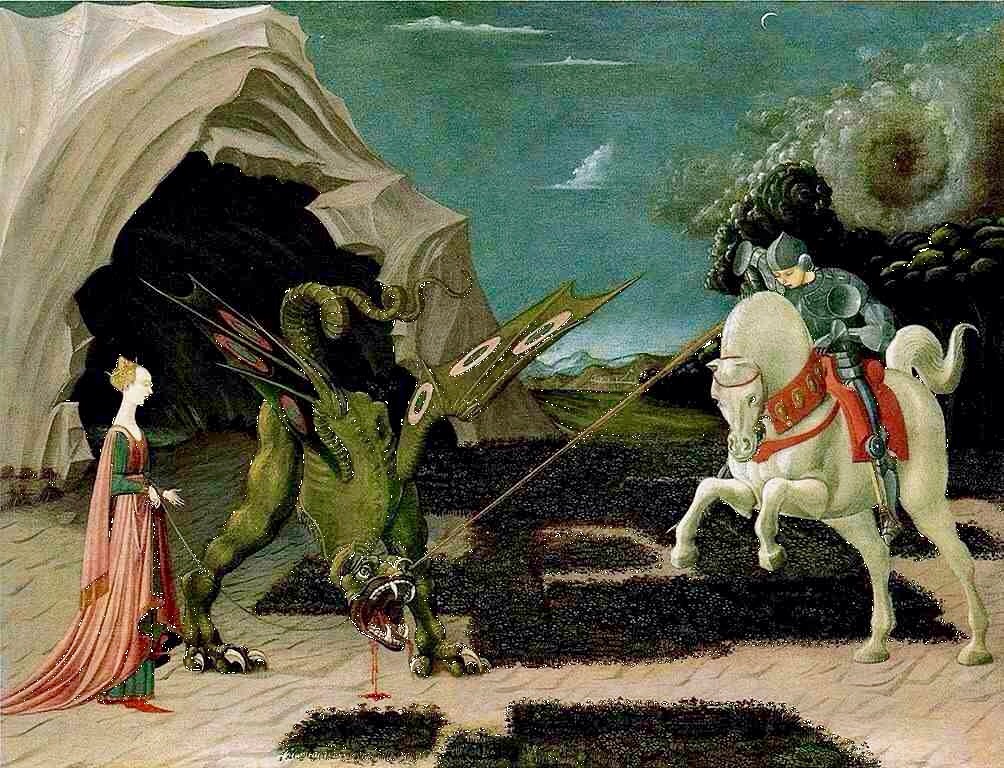
This week I discovered Albrecht Altdorfer’s ‘Saint George and the Dragon.’

I’ve been inspired before by Uccello’s version, which heralded the Renaissance and redrew the rules of painting with its extreme perspective as below.

IMG_3155.JPG

But Altdorfer’s small panel painted in 1510 was revolutionary in its own right. It was the intermediate ‘evolutionary form’ between portrait and landscape. Within a decade of ‘Saint George!, Altdorfer was painting and printing some of the first “true” landscapes in Northern Europe.

The dense forest dominates a tiny Saint George looking diffidently at the rather uninspiring dragon. His horse doesn’t fancy it much, and the whole scene – robbed of the customary ‘damsel in distress’ of Uccello’s has a ‘more in sadness than in anger’ feel.

IMG_3149.PNG

Here’s what Daily Art App has to say:

This tiny panel (22.5cm x 28cm) is filled with the ferocious wildness of the forest, from which the lumpy, froglike dragon seems to emerge, slobbering with primordial slime.

In a little window where the trees open, the light of the outside world burns through. St. George is not in the act of killing the dragon—rather, he seems to be looking down on it with pity. His lance hangs limply at his side.

Altdorfer’s George looks tired, his armor is dingy, and the horse seems to shrink back in disgust at the sight of the formless, murky dragon.

The figures become lost in the ferocious foliage (ferocious like the dragon traditionally should be) which threatens to choke out the figures themselves (who should traditionally be the focus), and they all seem to merge into monochrome.

The knight seems to be musing on something within himself which he knows he must slay in order to leave the dark forest of the unconscious and emerge

Although Uccello’s is one of my favourite paintings (forever associated, in my mind, with the buzz and bustle of London due to its place on wall panels at Charing Cross tube) Altdorfer’s is more my type of Saint George.

A thing to be done but not revelled in. A certain amount of ambiguity, a fearful horse and a lumpen unfortunate dragon – a moment of pause and perhaps uncertainty.

Few true acts of ‘bravery’ in real life are as clear cut as Uccello’s. Most have the ambiguity and uncertainty of Altdorfer’s Saint George – which usually makes them all the braver.

History

IMG_3134.JPG

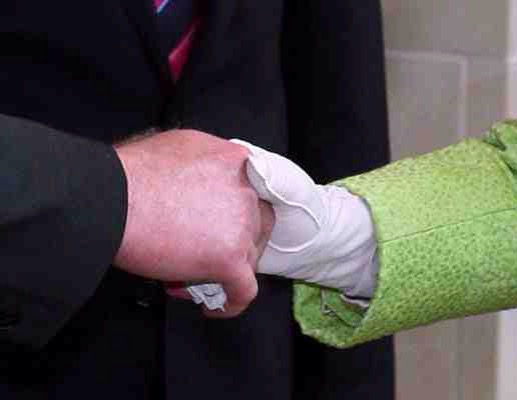
A poignant moment for me but one amongst millions for her – this week I shook (quite gently) HRH The Queen’s gloved hand.

At the launch of a new Academy of International Relations, I stood in line; first to be inspected by Prince Philip, before the immaculate, steady grace (and not a single silver hair our of place) of her Majesty.

We exchanged no more than a few words and she was on, and gone. The intensity of her eyes, and the very clear focus within them is striking. She doesn’t say a lot, but she doesn’t miss a thing. And what things she has seen in a long and very public life.

Whatever you think of the monarchy, she is dignity and hard work personified. A time-capsule of Britain and the world’s history. And on a very ordinary grey Tuesday night in November I shook her hand – which I makes it a grey ordinary Tuesday, I will remember for the rest of my life.