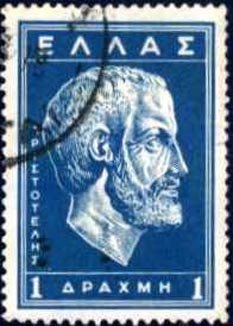
Poetics

Aristotle is always refreshingly plain on a subject. So when I read him, I find it easy to think he’s simply making a useful summary of a well known issue. But often he was creating the entire discipline; the first known thinker to frame or classify it. This makes his clarity and brevity all the more remarkable. And all this in 350 BC.

Among his intellectual inventions was the first setting out of the principles of ‘Poetics’, covering drama, tragedy and a lost volume on comedy.

Here he explains the origins and evolution of poetry:

Poetry in general seems to have sprung from two causes, each of them lying deep in our nature. First, the instinct of imitation is implanted in man from childhood, one difference between him and other animals being that he is the most imitative of living creatures, and through imitation learns his earliest lessons; and no less universal is the pleasure felt in things imitated.

Imitation, then, is one instinct of our nature. Next, there is the instinct for ‘harmony’ and rhythm, meters being manifestly sections of rhythm. Persons, therefore, starting with this natural gift developed by degrees their special aptitudes, till their rude improvisations gave birth to Poetry.

Poetry, myth and tragedy played important roles in Ancient Greece. According to Nietzsche they were instrumental in maintaining the vitality and optimism of Greek culture. Poetry, myth and tragedy also captured the essence of Ancient History. As Aristotle said:

Poetry is finer and more philosophical than history. For poetry expresses the universal and history only the particular.

Perhaps, like philosophy, poetry is less central to modern culture. But it’s still takes the same courage and skill:

Constantly risking absurdity, whenever he performs above the heads of his audience, the poet like an acrobat climbs on rime. (Lawrence Ferlinghetti, 1958)

It also connects the sublime with the ridiculous in the human condition:

Poetry is the achievement of the synthesis of hyacinths and biscuits. (Carl Sandburg, 1928)

But philosophy and poetry can still bring happiness, fulfilment and an opportunity to develop our natural gifts – till our ‘rude improvisations’ give birth to our own poetry.

Incandescence

This week, I advanced my new theory – to a gently sceptical friend – that the brain works (at least partly) like the electronic ink screen of an Amazon Kindle. Blending in the philosophy of St Thomas Aquinas, my sweeping conclusion was he should get angry more. Here’s why.

Since buying a Kindle, I’ve been impressed that the screen, when you switch it off, maintains a complex picture – a person, a constellation, a painting etc – using no energy at all. It’s simple but impressive. Like a screensaver, but without power. Information and knowledge are thus available to be viewed, at any time, at no energy or processing cost. My theory is the brain has the same capacity.

A few years ago I read that neurones aren’t permanently ‘charged’ like little lightbulbs or LCD pixels but store information passively – more like a physical switch or dial. Energy is used to ‘charge’ them with information, but once they have been ‘set’ with information they store it passively until changed. Good job too, or, given the number of neurones we have, we’d need a nuclear generator to power our heads.

So my emerging thesis is we can ‘poll’ in computer lingo, or rapidly access a snapshot our entire accumulated summary of knowledge and experience in an instant. And in that instant we can act or react subconsciously informed by that summary.

My guess is that none of this requires much in the way of conscious cognitive processes. Like a finger recoiling from a nail or a smile drawing a return smile, we can immediately and effectively respond to people and situations against this dataset. I’m not saying it is innate or preloaded. We are constantly checking, updating and rearranging our vast neuronal data-set. But at any instant, my thesis is, it lies latently ‘there’ encrypted in neurones like the patterns which make a rich picture, or a page of words, out of electronic ink.

Of course we can intervene, ignore, debate or challenge our accumulated data. Any instant ‘gut’ reaction, or action, it may recommend can be overruled. In complex or nuanced circumstances the higher cognitive functions kick in – at least most of the time.

And this connects to my ongoing conversation with my friend on Aquinas’ support for ‘ira’, and the set of passions which include anger. Like Aristotle – in fact far more than him – Aquinas was pro anger in the right circumstances. Surprising for a theologian.

He thought the passions were intrinsic parts of who we are. He thought they were forms of reason, not lower ‘animal’ or ‘bodily’ sensations to be suppressed by our purer ‘mind’ or ‘soul’. Thus, our passions come from our instincts, blended with our default ‘Kindle screen’ summary of experiences, beliefs and our lifetime of accumulated and refined knowledge. They all inform each other.

I’m with Aristotle that we are what we repeatedly do. So we are constantly refining and tuning our passions, our experience dataset and our virtues through action – only some of that helped by conscious reflection. I’m increasingly with Aquinas too, that it all comes together in complex single holistic system – an ‘anima’, aka a person, not a dumb body and a smart, reasonable mind.

As Herbert McCabe points out: for Aquinas the good life is a passionate life; not achieved by the repression of passions, but by passions guided by virtues. Perhaps there’s more to be said for trusting our ‘gut’, allowing moments of ‘ira’ and the occasional incandescence of righteous anger. Once you’ve lived a few decades and developed a bit of virtue, it’s pretty well informed.

The Undiscovered Continent

I discovered a poem I liked by Emily Dickinson in a poetry anthology. Her words seemed fresh, direct and unaffected. So I looked to see whether she was still writing. A surprise then to see she wrote the words in 1862.

I asked my partner who knows more about literature than me. ‘She’s American, I think’ she said. Transpires she is, from Massachusetts. Reclusive and introverted, Emily lived through letters. But, as with many writers throughout history, it only became evident how much she’d written after her death. Thousands of poems.

She lived much of her later life in what she called the ‘undiscovered continent’ of the mind and soul. She seemed to think of it as an almost a physical place you can inhabit and explore.

This set me thinking – puttering through slow traffic today – of Socrates. He thought everything could be discovered by earnest dialogue and reason – the answers are all there to be found in our heads if we are rigourous and vigourous enough.

Or Berkeley the ‘idealist’ philosopher, who argued that everything we see, touch and feel is ‘mind’ not matter. Then there are contemporary philosophers, who tease undergraduates with solipsism, asking ‘Are we sure it’s not all in our heads’.

The ‘undiscovered continent’ of the mind is a tempting destination. But it’s attractions need to be treated with care. Life is enriched by real world observation and experience and is best explored with friends.

A reclusive life might find order. But the beauty and brutality of nature, the intense experiences of life and the fickle gods of chance are in the material world. The ‘undiscovered continent’ is a place I like to visit, but isn’t a place to live I feel.

Here’s the line from Emily Dickinson which drew me to her and her poetry.

I dwell in possibility, a fairer house than prose, more numerous of windows – superior for doors.

Bees

http://www.flickr.com/photos/autanex/I was talking to a very good friend yesterday about bees. It came up in a digression about the very different ways some people find to live a life.

He described the case of a foal, born prematurely, who had imprinted on the people who’d nurtured it. Spurning other horses, the foal considered itself eminently human and preferred the company of people. A problem for it and them.

More remarkable was the solution – a horse-whispering woman – who makes a living going round the country brokering misguided premature foals back into the world of horses. She eases their separation from the two-legged world back to four.

In exchange, I told him about my conversation with a nomadic beekeeper this spring. Bee keeping, it appears, is all about titivating, then tempering, the hive’s desire to swarm. A healthy, happy, busy hive is a productive hive. But a productive hive is also an unstable one.

Experienced workers get itchy feet and start looking for new opportunities. Young upstart queens start getting restive, fancying their own realms. The hive is dripping with honey, but disaster threatens – 60% of the hive swarming off with a new queen – leaving a remnant hive which will take a year to produce again. No honey for the autumn pot.

Separating queens, creating sub-hives, clipping wings are all recognised measures. But the more the beekeeper gambles, the more risk that several queens buzz off. Or worse, the entire hive ‘absconds’ in the vernacular. Ouch. My nomadic beekeeper had about five queens on the go, in three sub-hives, all itching to swarm and pumping honey like a Texas gusher. He lives his beekeeping on the edge.

In olden days they worried less. Beekeepers trusted to chance and mother nature. Wikipedia offers the wisdom of a gentler era:

Old fashioned laissez-faire beekeeping depended upon the capture of swarms to replenish beekeeper colonies and early swarms were especially valued. An old English poem says:

A swarm of bees in May is worth a load of hay;
A swarm of bees in June is worth a silver spoon;
But a swarm of bees in July isn’t worth a fly.

The world of bees has moved on from the buzz and burr of rural idyll. Much like the world of work, it’s all more organised now. Productivity and efficiency are to the fore not serendipity and chance.

My friend and I agreed, with bees – as in working life – keeping the hive busy and productive is a fine art. Swarming costs you honey and money. Disturbing the hive gets you stung. One of my golden rules for work, is never whack too many beehives at once.

There is evidence, the nomadic beekeeper told me, that honey bees followed humans out of Africa. Who was following whom and who got more from it I wonder? Bees are eusocial – they work together. Humans are social and selfish simultaneously, only very careful beekeeping keeps a human hive happy. There’s a lot we can learn from bees.

Superhero

20110619-111639.jpgMy son announced this morning, in the car, that he has the superpower of sellotape. This enables him to stick inanimate objects together almost at will.

Fired from his hands in the manner of Spiderman’s webs, I remarked that his sellotape shots could prove mighty useful at present wrapping time. But his sister wasn’t impressed.

‘Show us then’ she challenged him. But he demurred. ‘I’m only a superhero on Tuesdays’ he said, confounding her. It’s hard work saving the world with sellotape, you have to sympathise. None of us can be a superhero every day.