Art and Artists

20120411-223341.jpg

I’ve started E.H. Gombrich’s ‘The Story of Art’ which was recommended by one friend and came up in conversation with another today. Gombrich says there is really no ‘Art’, only artists and what they create.

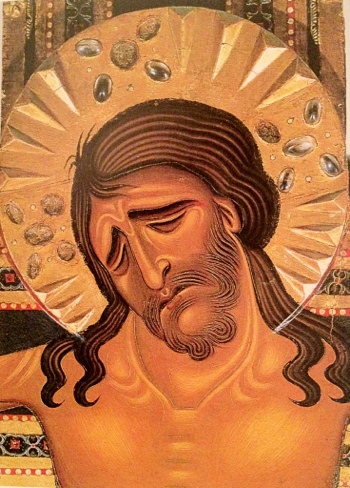
A lot of what what ‘Art’ is actually about, is nothing to do with experts, critics, audiences or patrons – it’s about the artist and their personal effort to produce something of intrinsic value. The painting above from ‘The Story of Art’ simply and powerfully captures not only the passion of Christ, but also the passion of the unknown 12th Century artist.

I pointed out today that this connects with one of my dictums for social media – if you like what you’ve done that’s good enough, don’t worry about anyone else. I think social media is largely about forgetting the ‘audience’ and simply writing or posting something you personally care about, are interested in or want to say. It then finds an audience through chance and serendipity.

At this point in our conversation today I was forced to bring in Aristotle – and we had a laugh about it. Aristotle is knockout reference once you buy into him. There’s often nothing more to say once you’ve heard what Aristotle said on a subject.

So, drawing on Aristotle’s ‘Poetics’, my definition of the job of the artist – and bloggers too, I reckon – is to forget about ‘Art’ or ‘audience’ and simply:

Say, write, paint or sculpt something transcendent and universal about the human condition in no more and no less words, notes, chisel blows or brush-strokes than are needed.

If it’s good it will find appreciation – if only from the person who matters most, the artist.
Autumn Sunrise

20111116-191114.jpg

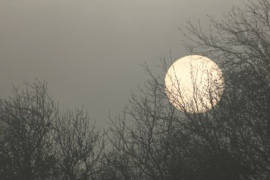
On a misty morning
With the kids in the car
Turning left
The surprise of a huge sun
Low in the sky
A silver gold blob
Just too bright to stare at
Not too bright to blind
Heralds
An emergent phenomenon
Not easily had
Coming into being
In my busy head
Happiness
More than a brain state
A life lived instead
Myriad things
In work at home at play
To bring together
Before it is found
Easily lost
A single moment can confound
But in simple pleasures
Doing the right things
Caring for people
About things
And oneself
Happiness shines
At times
Just too bright to stare at
Not too bright to blind.

I talked to a taxi driver today – an old man and a nice one. He revealed he studied art a good many years ago. Very much against the odds on a scholarship, he went to the art school at the bottom of our road – near where he was taking me.

He said other cabbies sometimes mock when he says he paints, but it brings him great peace and satisfaction. I owned up that I’ve started writing poetry too. We found ourselves kindred spirits. It’s not always the winning, it’s often the taking part with art. This poem refers to yesterday, but some of the warm glow spilled into today’s conversation.

Tragedies

I thoroughly enjoyed reading Simon Armitage’s updating of The Odyssey this week – a rattling good read, in my view. Our hero Odysseus, helped by Athene – and in spite of Poseidon and the only sometimes benign neglect of Zeus – overcomes a decade of trials and torments to return to the arms of his long-suffering Penelope.

Serendipitously, I also heard a Philosophy Bites about Nietzsche’s The Birth of Tragedy. Nietzsche argued Greek Tragedies were the perfect human and artistic response to the balance of ‘Dionysian’ chaos and ‘Apollonian’ order in life. The world is chaos and disorder (fickle gods) but humans can briefly rise above that to create pockets and moments of order (depending on the goodwill of the gods).

This tension of chaos and order, it is suggested, energises, drives virtue, excellence and courage and guards us against hubris and vanity. For Nietzsche, tragedies and myths enriched and invigorated Athenian culture, fuelling its dynamism, optimism and creativity – a latter day ‘Yes we can’ despite all evidence to the contrary.

I think he’s onto something. Planet Earth is an extraordinarily delicate life-boat in a cosmos of nothingness occasionally punctuated by ice, fire and crushing gravity. And our world wasn’t always so benign. On hols in France – watching an improbably large stork fly overhead – I was reminded of massive raptors bouyed by high levels of atmospheric oxygen, avoiding the constant vulcanism and raging forest fires which were the Carboniferous era. Pretty Dionysian. As The Odyssey teaches we can be heroic and stoic, but we are mere mortals against primal forces.

Enter Socrates – everything can be learned, mastered and understood by unrelenting reasoned debate and dialogue. The human mind can penetrate the deepest mysteries and bring order to nature’s chaos. And indeed we can to some degree – with a bit of observation and Aristotle’s scientific method thrown in. But like Odysseus, Achilles or Icarus we can all be raised up and brought low by the fates, with only chaos and chance as explanations.

For Nietzsche the pre-Socratic Greeks had it right. Tragedy and myths were the spiritual batteries of their culture – their way of coping with an unpredictable and inhospitable mother nature. But they could, through luck, bravery and virtue, enjoy moments of truimph and joy. Art lifted their spirits and their culture.

But then along came Socrates who badgered us into believing the world was rational. I like the Socratic method – stepping outside your own beliefs to examine them and debate them with others – but not his unintended consequence. Nietzsche accuses Socrates of killing art with reason and, with it, art’s ability to help us live with and laugh in the face of chaos.

I’ve cited Armitage’s Odysseus three times at work this week. It helped me and others understand and deal with our workplace fates and some all too human failings. It made us reflect, laugh a bit and cope better. Art imitating life or life imitating art? Either way, stepping outside our local tragedies to reflect on ancient ones seemed to help.

Art

A super article in the New Scientist explains – as artists have intuited down the centuries – that the brain works to a different set of rules than the real world.

We have misread shadows and mirrors from Velazquez Rokeby Venus to Bond’s Scaramanga but most of the time we get it right. I’m going to look up Patrick Cavanagh of Paris Descartes University’s work, but in essence the visual tricks of Dali and Escher and the deeper emotional connection made by a Monet are no accidents.

As the New Scientist summarises ‘You can’t do a proper analysis of all the laws of physics in in the 10th of a second it takes your visual system to form an image so we evolved a simple set of rules that can be computed rapidly without requiring a large proportion of the brain.’ This also means it can be tricked.

I think our visual system may be like our ‘ethical system’. We have evolved a simple, but very powerful set of rules constantly improved by experience through our Bayesian brains. However like an untrained artistic eye if we don’t examine and assess our moral judgements we may not learn and improve and thus fall short of a virtuous and fulfilled life. We can all draw an object but very few can render it perfectly or change the way others see it. Our ‘Ethical eye’ although primarily instinctive is worth training I believe.

I also think the odd checklist helps. I read something a few months back about the astonishing improvements in surgical outcomes achieved by simply running through a checklist – not least checking “have I left any surgical instruments in the person”. Pilots have known it for years, rudders – check, instruments – check, honesty – check, courage – check.

An Aristotelian list is not a bad checklist:

Courage
Temperance
Liberality
Magnificence
Pride
Honour
Good Temper
Friendliness
Truthfulness
Wit
Friendship

11 is a lot to remember, but the good thing of course is I don’t have to. Simply follow my gut (it’s all simplified, instinctive and instantly available in there) and periodically assess and train the Bayesian brain.

Much easier than painting a Monet.