Rhetoric

I’ve been doing a lot of presentations on strategy in the last few weeks. The good news is people say it’s all very clear. They like it. “A lot better than it was too” some say. I acknowledge, slightly wistfully, that our old strategy was bigger on soaring rhetoric – and I miss that a bit. But not much. Clear and credible is better.

Reading Montaigne and Aristotle on Rhetoric I can see why. Montaigne first:

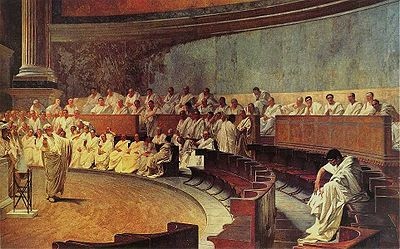
Eloquence most flourished at Rome when the public affairs were in the worst condition and most disquieted with intestine commotions; as a free and untilled soil bears the worst weeds.

Oh dear – suggests I may have been part of indigestion in our organisational intestines. Our rich intellectual soil allowed many rhetorical flowers to bloom. Perhaps some tilling was called for.

Aristotle for his part, in his encyclopaedic and comprehensive way, offers three volumes on Rhetoric covering it’s function, forms and stylistic niceties.

A dense but magisterial account on the Stanford Encyclopaedia of Philosophy runs through Aristotle’s work. In essence the purpose of rhetoric is to persuade. It is neutral and can be used well or badly and for good or for ill. The Rhetorician, like the physician should be judged, not, on whether he or she saves every patient or wins every argument, but on his or her use of the relevant tools, interventions and skills.

The Stanford encyclopaedia offers that persuasion itself depends on (a) the character of the speaker (b) the emotional state of the hearer (c) in the argument (logos) itself. The speaker can employ his or her skills as a stimulus for the sought emotion (pathos) from an audience. However, along with pathos, the speaker must also exhibit ethos, which for Aristotle encompasses wisdom (phronesis), virtue (arete), and good will (eunoia).

Persuasion is accomplished whenever the speech is recieved in such a way as to render the speaker worthy of credence. If the speaker appears to be credible, the audience will form the second-order judgment that propositions put forward by the credible speaker are true or acceptable. The catch is for it to be true Rhetoric the speaker must accomplish these effects by what he or she says; it is not necessary that he is actually virtuous: on the contrary, a preexisting good character cannot be counted part of the technical means of persuasion.

So is Rhetoric mainly about cheating and what you can get away with? And if so why would a man of Aristotle’s leanings engage with it? Well as the Stanford Encyclopaedia explains it:

It could be objected that rhetoric is only useful for those who want to outwit their audience and conceal their real aims, since someone who just wants to communicate the truth could be straightforward and would not need rhetorical tools. This, however, is not Aristotle’s point of view: even those who just try to establish what is just and true need the help of rhetoric when they are faced with a public audience.

Aristotle tells us that it is impossible to teach such an audience, even if the speaker had the most exact knowledge of the subject. The audience of a public speech consists of ordinary people who are not able to follow an exact proof based on the principles of a science. Further, such an audience can easily be distracted by factors that do not pertain to the subject at all; sometimes they are receptive to flattery or just try to increase their own advantage. And this situation becomes even worse if the constitution, the laws, and the rhetorical habits in a city are bad (as in Montaigne’s Rome above).

Finally, most of the topics that are usually discussed in public speeches do not allow of exact knowledge, but leave room for doubt; especially in such cases it is important that the speaker seems to be a credible person and that the audience is in a sympathetic mood. For all those reasons, affecting the decisions of juries and assemblies is a matter of persuasiveness, not of knowledge.

But, reassuringly, at the heart of Aristotle’s approach to rhetoric – as you would expect of the man – is a belief in substance over style:

Aristotle joins Plato in criticizing contemporary manuals of rhetoric. Previous theorists of rhetoric gave most of their attention to methods outside the subject; they taught how to slander, how to arouse emotions in the audience, or how to distract the attention of the hearers from the subject.

Aristotelian rhetoric is different in that it is centred on a rhetorical kind of proof, the ‘enthymeme’ which he called the most important means of persuasion. Since people are most strongly convinced when they suppose that something has been proven, there is no need for the orator to confuse or distract the audience by the use of emotional appeals, etc.

In Aristotle’s view an orator will be even more successful when he just picks up the convincing aspects of a given issue, thereby using commonly-held opinions as premises. Since people have a natural disposition for the true there is no unbridgeable gap between commonly-held opinions and what is true.

For Aristotle, the speaker does need to recognise that his or her audience may not have the habit of scientific proofs. He also concedes that long chains of logical inferences might not work well either. But, in his view, every man is open to bridging the gap between commonly-held opinions and the truth. So good rhetoric draws on both.

As for style, as with his ethics it’s all about the ‘golden mean’. In a nutshell for Aristotle the good style is ‘clear in a way that is neither too banal nor too dignified, but appropriate’. Nice.

I conclude the reasons I need less rhetoric these days is 1) our organisational intestines are in better order 2) more of what we are doing accords with commonly-held beliefs and thus 3) I need far fewer appeals to emotion and long chains of inferences to make my case. All that’s left is to add a spot of Ethos and Pathos and the job is done. Time for a rhetorical rest.

Cathedral or Cave

I imagine Aristotle, like the Acropolis, as more Cathedral. The reclusive poet Emily Dickinson would be more cave. Montaigne, perhaps old Paris; earthy rumbustious streets and deep reflective catacombs.

I’ve been toying with Nietzsche’s idea that our ‘will to power’ is either expressed in the real world or forcibly turned in. For him, we create a complex inner life in proportion to the scale of our drive we cannot express externally.

It’s an interesting thought. Complex interesting people tend to have a good deal of both – rich inner lives and fulfilling outer ones. But not always. Nietzsche credits civilisation with curbing the capacity to express our animal instincts externally – driving them inwards. This unexpressed energy drives our inner lives – our conscience, guilt and creativity.

I think regularly about the balance of inner and external. I don’t feel I have the ‘will to power’ for a full ‘Cathedral’ in the external world. Too much competition, conflict, one-upmanship and strife in seeking grandeur. I fear I’d lose my health, precious time with my family and my happiness if I allowed a ‘grand projet’ or personal aggrandisement to consume me.

Talking to a friend – who is a decade older than me – this week, I felt a bit guilty. He has real fire in his belly for systemic reform, transformational change and the great debates of public policy. I said I’m just not attracted to any of that right now.

We talked about using your talents and our responsibility to improve the lot of others. He started his career as a lone residential social worker, on a tough housing estate. Beer bottles bounced off the cage that surrounded his outpost all night. That’s where his fire still comes from. It drives him to want to improve the scaffolding and superstructure of the nation’s health and social care system.

I don’t have that. I’m more a family chapel with a good sized intellectual cellar. My projects are more local and small scale – my family, the people around me. But never say never. The world is an unpredictable place. Gaudi started with lampposts and squat schoolhouses, so I suppose you never really know what you might build one brick at a time.

Xerxes

Xerxes – controversially portrayed as a narcissistic androgynous giant in the blood-spattered film 300 – broke with Persian tradition and laid waste to allies and enemies with enormous forces, before losing interest, losing ground and retiring to lotus eating and luxury. Or so some say.

His patina of invincibility was chipped by Leonidas’s legendary 300 Spartans’ suicidal defiance at the ‘hot gates’ of Thermopylae. A Persian General said of them: “Ye Gods, Mardonius, what men have you brought us to fight against? Men that fight not for gold, but for glory.” Spartans sought their immortality in glorious death.

In film and folklore Xerxes was a god amongst men before succumbing to human frailties. Is Xerxes a myth, a legend or history? Probably a bit of all three. A reading of Robert Graves’ Greek Myths suggests most ancient history, legend and mythology is in fact a bit of all three.

But a tale from Montaigne’s suggests that even as Xerxes set out to conquer all, he saw, in the same instant, the limits to his dominance:

Montaigne XXXVII

Artabanus coming by surprise once upon his nephew Xerxes, chid him for the sudden alteration of his countenance. He was considering the immeasurable greatness of his forces passing over the Hellespont for the Grecian expedition: he was first seized with a palpitation of joy, to see so many millions of men under his command, and this appeared in the gaiety of his looks: but his thoughts at the same instant suggesting to him that of so many lives, within a century at most, there would not be one left, he presently knit his brows and grew sad, even to tears.

Greek myths tell us that power and glory are always transient. Even the most powerful among us are mayflies in historical, let alone geological time. Xerxes is a reminder that men cannot be gods. We have at best three score and ten, whether we are millions or 300 men. It behoves us to use our time well.

Poetry in Motion

A few weeks ago, newly enamoured of poetry, I wrote a short ditty to capture what I think increasingly drives my life. It came out quite easily so I guessed it might be quite close. But then I forgot about it. Sat in traffic in the rain today, the last two lines came back to me unbidden. It has clearly lodged in my subconscious. So here it is:

Pay attention to life with bright eyes and keen ears.
Helped by poets and thinkers, refine hopes; master fears.

Embroider each minute and day of my years
with friendship and love and knowledge and ideas.

And the main credits are: for line 1) Montaigne and Aristotle; line 2) Aristotle, Kay, Csikszentmihalyi, Nietzsche, Homer, Armitage, Aquinas, McCabe, Socrates, Stoics, Sceptics; line 3) Me latterly; and line 4) Aristotle, Aquinas, my Friends in Contemplation, my family, reading, writing, work.

I’m not sure I’ll get a poster on the subway for these lines of rhyme, but they are pretty much where Eudaimonia lies for me I think.

Poppies

On holiday in France, I started reading Herbert McCabe on St Thomas Aquinas. I’d heard Sir Anthony Kenny in a ‘Philosophy Bites’ podcast describing Aquinas as deserving as much attention from we moderns as Aquinas himself paid to Aristotle in his day – a great medieval foundation on which to build.

On a prominent bookshelf, in the holiday home we were staying in, Aquinas merited two volumes – Aquinas I and II – in the leather bound ‘Britannica’s Great Books of the Western World’. Only one other philosopher got two whole volumes… you guessed it – Aristotle. Good references then.

I’m too early into Aquinas to know how much is him and how much is McCabe building on him. But reading McCabe’s account, a whole series of philosophical concepts and ideas which I ‘learned’ at University are now a lot clearer to me.

Souls, existence and being are all brought to life, but also the significance of language. I never really got why modern philosophers were so hung up on language. Yes it’s an important skill, yes it codifies our world, but presenting it like maths is to science – underpinning everything we are, think and can know of the world – seemed to overrate ‘words’ to my undergraduate mind.

Take ‘redness’ I can accept your idea of red might overlap with mine, or be subtly different or be missing altogether if you’re colour blind. I can further accept my dog or a leopard might see it differently again, and a plant not at all. But as a good post enlightenment ‘atomist’, I felt ‘redness’ was ‘real’ not subjective. Whatever jingling of photons against molecules it is, ‘red’ for me was the name for a real ‘observable’ characteristic of the handsome poppies dotted in the wheatfields of Charente-Maritime.

I’m attracted by McCabe’s account that the big difference between a car and a cheetah, is one is made of parts, the other is only comprehensible as a whole. One can be taken apart and put back together again, the other can’t. One can exist uniquely as the only one of it’s kind, the other requires mates, progenitors and offspring to come to exist and continue to truly exist.

And so it is with humans. What we call ‘red’ is the product of millions of years of evolution and thousands of years of language – in an unbroken physical, linguistic and cultural chain. This unbroken chain can be ‘atomised’ into its constituent parts – which certainly helps us to grapple with what is and isn’t ‘red’, but that doesn’t really capture the phenomenon or the ‘phenomenology’.

There is no ‘red’ without humans to see it and a shared human language to describe it. We can describe the photons bouncing off the lattice of the petal, hitting the retina and sparking the neurones. Using language we can think hard about it and describe it to others. But before there was language to describe it, think it and name it there was no ‘red’. There were plants but no poppies.

What I call a poppy, Montaigne would have recognised as a pavot, Aquinas as a papaver and Aristotle as a παπαρούνα. Same sensory apparatus, languages from the same family tree, many common cultural references. Different words, similar – although never exactly the same – human experience: ‘redness’.

Being part of that unbroken chain of evolution, languages, knowledge and ideas is far richer than photons bouncing off a lattice. It’s good to look at the parts, but as Aquinas reminds us, it is the whole which is the special bit.