 I’ve been doing a lot of presentations on strategy in the last few weeks. The good news is people say it’s all very clear. They like it. “A lot better than it was too” some say. I acknowledge, slightly wistfully, that our old strategy was bigger on soaring rhetoric – and I miss that a bit. But not much. Clear and credible is better.
Reading Montaigne and Aristotle on Rhetoric I can see why. Montaigne first:
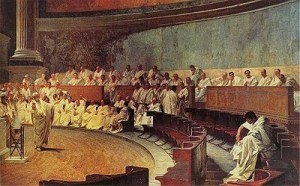
Eloquence most flourished at Rome when the public affairs were in the worst condition and most disquieted with intestine commotions; as a free and untilled soil bears the worst weeds.
Oh dear – suggests I may have been part of indigestion in our organisational intestines. Our rich intellectual soil allowed many rhetorical flowers to bloom. Perhaps some tilling was called for.
Aristotle for his part, in his encyclopaedic and comprehensive way, offers three volumes on Rhetoric covering it’s function, forms and stylistic niceties.
A dense but magisterial account on the Stanford Encyclopaedia of Philosophy runs through Aristotle’s work. In essence the purpose of rhetoric is to persuade. It is neutral and can be used well or badly and for good or for ill. The Rhetorician, like the physician should be judged, not, on whether he or she saves every patient or wins every argument, but on his or her use of the relevant tools, interventions and skills.
The Stanford encyclopaedia offers that persuasion itself depends on (a) the character of the speaker (b) the emotional state of the hearer (c) in the argument (logos) itself. The speaker can employ his or her skills as a stimulus for the sought emotion (pathos) from an audience. However, along with pathos, the speaker must also exhibit ethos, which for Aristotle encompasses wisdom (phronesis), virtue (arete), and good will (eunoia).
Persuasion is accomplished whenever the speech is recieved in such a way as to render the speaker worthy of credence. If the speaker appears to be credible, the audience will form the second-order judgment that propositions put forward by the credible speaker are true or acceptable. The catch is for it to be true Rhetoric the speaker must accomplish these effects by what he or she says; it is not necessary that he is actually virtuous: on the contrary, a preexisting good character cannot be counted part of the technical means of persuasion.
So is Rhetoric mainly about cheating and what you can get away with? And if so why would a man of Aristotle’s leanings engage with it? Well as the Stanford Encyclopaedia explains it:
It could be objected that rhetoric is only useful for those who want to outwit their audience and conceal their real aims, since someone who just wants to communicate the truth could be straightforward and would not need rhetorical tools. This, however, is not Aristotle’s point of view: even those who just try to establish what is just and true need the help of rhetoric when they are faced with a public audience.
Aristotle tells us that it is impossible to teach such an audience, even if the speaker had the most exact knowledge of the subject. The audience of a public speech consists of ordinary people who are not able to follow an exact proof based on the principles of a science. Further, such an audience can easily be distracted by factors that do not pertain to the subject at all; sometimes they are receptive to flattery or just try to increase their own advantage. And this situation becomes even worse if the constitution, the laws, and the rhetorical habits in a city are bad (as in Montaigne’s Rome above).
Finally, most of the topics that are usually discussed in public speeches do not allow of exact knowledge, but leave room for doubt; especially in such cases it is important that the speaker seems to be a credible person and that the audience is in a sympathetic mood. For all those reasons, affecting the decisions of juries and assemblies is a matter of persuasiveness, not of knowledge.
But, reassuringly, at the heart of Aristotle’s approach to rhetoric – as you would expect of the man – is a belief in substance over style:
Aristotle joins Plato in criticizing contemporary manuals of rhetoric. Previous theorists of rhetoric gave most of their attention to methods outside the subject; they taught how to slander, how to arouse emotions in the audience, or how to distract the attention of the hearers from the subject.
Aristotelian rhetoric is different in that it is centred on a rhetorical kind of proof, the ‘enthymeme’ which he called the most important means of persuasion. Since people are most strongly convinced when they suppose that something has been proven, there is no need for the orator to confuse or distract the audience by the use of emotional appeals, etc.
In Aristotle’s view an orator will be even more successful when he just picks up the convincing aspects of a given issue, thereby using commonly-held opinions as premises. Since people have a natural disposition for the true there is no unbridgeable gap between commonly-held opinions and what is true.
For Aristotle, the speaker does need to recognise that his or her audience may not have the habit of scientific proofs. He also concedes that long chains of logical inferences might not work well either. But, in his view, every man is open to bridging the gap between commonly-held opinions and the truth. So good rhetoric draws on both.
As for style, as with his ethics it’s all about the ‘golden mean’. In a nutshell for Aristotle the good style is ‘clear in a way that is neither too banal nor too dignified, but appropriate’. Nice.
I conclude the reasons I need less rhetoric these days is 1) our organisational intestines are in better order 2) more of what we are doing accords with commonly-held beliefs and thus 3) I need far fewer appeals to emotion and long chains of inferences to make my case. All that’s left is to add a spot of Ethos and Pathos and the job is done. Time for a rhetorical rest.
 I’m certainly not a morning person. Like a British Leyland car of the 1970s (of which we had a few) I start reluctantly with several turns of the key, a lot of choke and a deep shudder. My son is a bit the same, newer bodywork, same starter-motor.


 Achilles & Aristotle